
Celadon Vessel: Paired Cranes in Raised Relief with Red Sun, 2024
This vessel is chosen by those who understand that restraint is not emptiness, but a disciplined decision about what must remain visible.
“The sun holds its place while two cranes pass through the vastness of the glaze.”
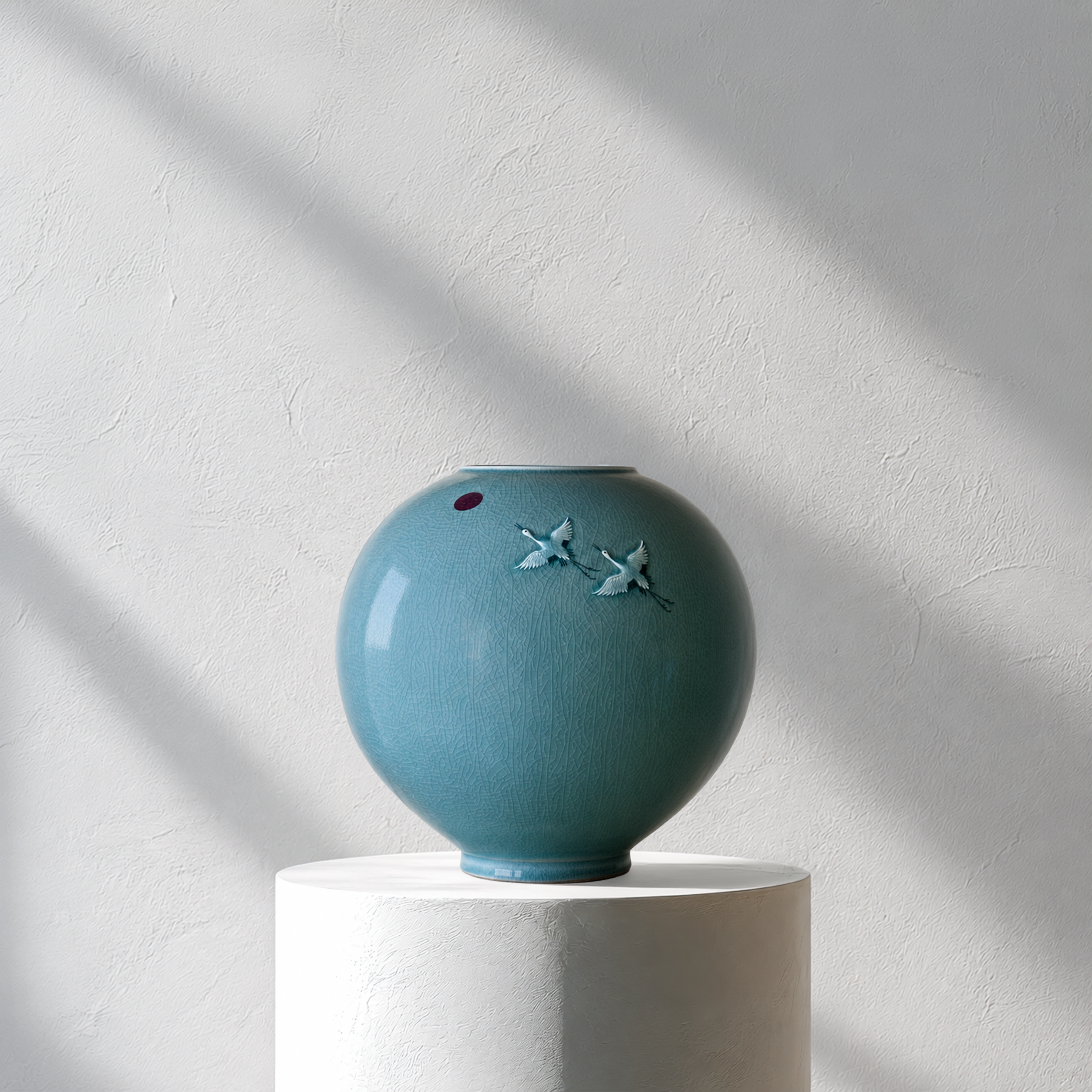
Created in 2024 by Kim Yong-seop, Master Ceramic Artisan of Icheon, this celadon vessel brings a small symbolic scene into relation with an unusually complete spherical body. The work is not organised as a decorated jar with a motif applied to its surface. Rather, the form itself becomes the condition within which the motif can exist: the rounded body provides sky, distance, horizonless space, and a quiet sense of enclosure.
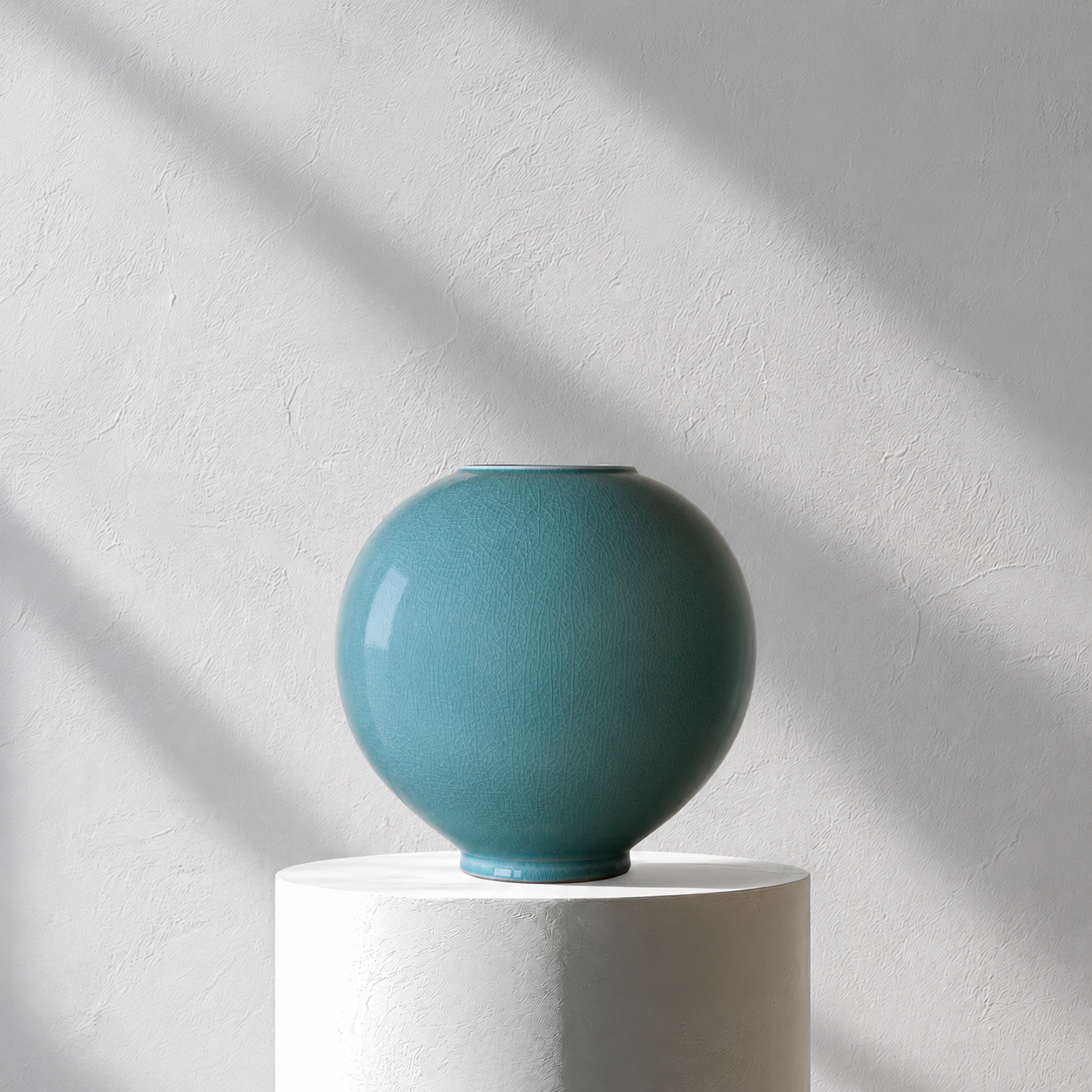
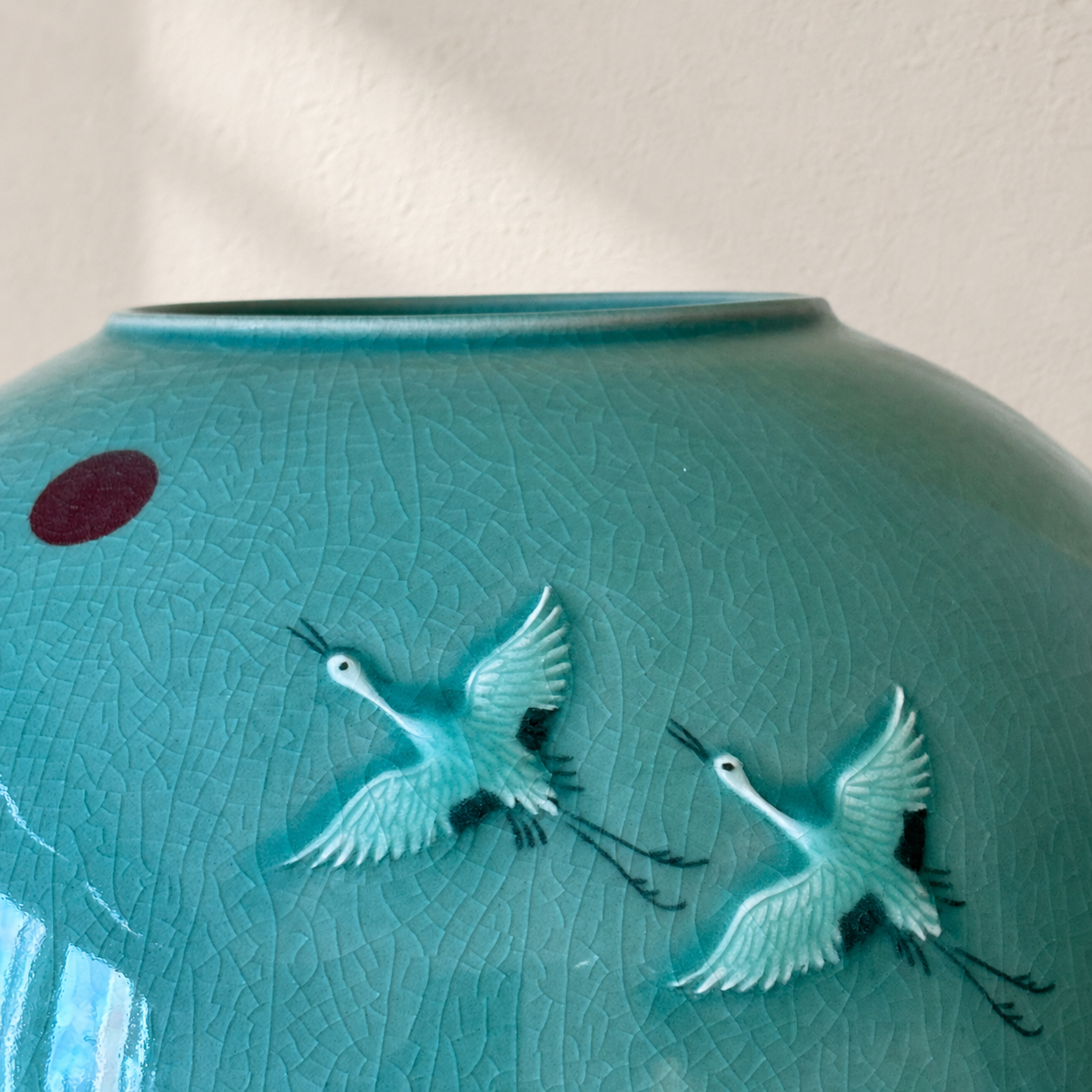
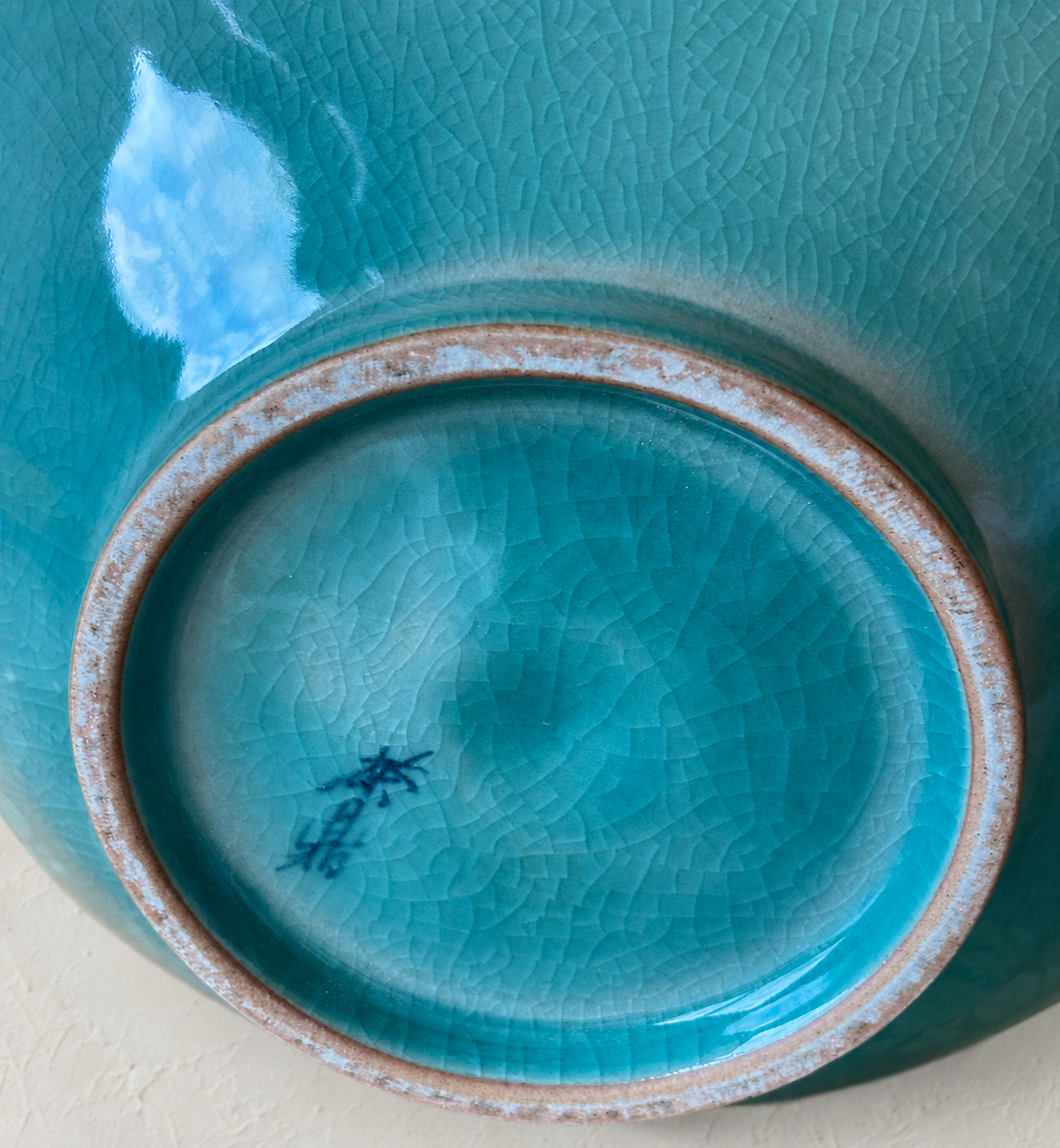
The vessel rises from a narrow foot into a broad, nearly globular volume. Instead of narrowing into a distinct neck, the shoulder continues upwards and closes around a recessed circular mouth. This decision removes the usual transition between body and neck, allowing the eye to travel over the surface without interruption. The object appears gathered into itself, as though its entire structure has been held within a single breath.
This continuity is both visual and technical. A conventional neck can help stabilise the upper portion of a vessel and provide a defined point of structural closure. Here, that support is reduced. The form must therefore maintain its rounded tension without the assistance of a pronounced vertical element. During drying and firing, any imbalance in wall thickness or curvature may lead to sagging, deformation, or collapse. The finished vessel’s apparent serenity is consequently inseparable from the difficulty of preserving its shape.
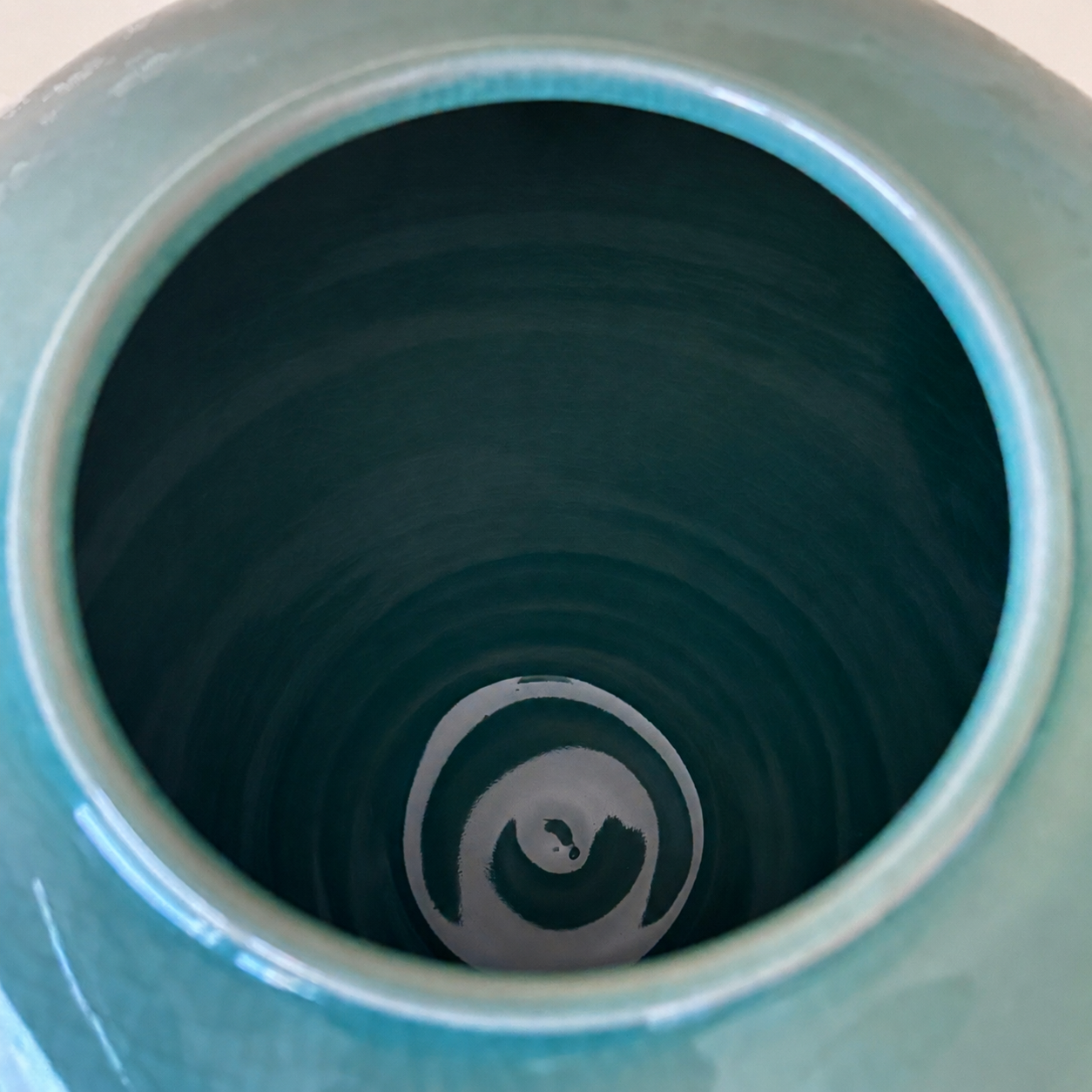
The shallow mouth contributes to this reading. From a distance, it almost disappears into the silhouette, allowing the vessel to approach the condition of a complete sphere. Seen from above, however, the opening reasserts the object’s identity as a vessel. The work moves between two understandings: it is an enclosed sculptural volume, yet it remains a hollow form with an interior.
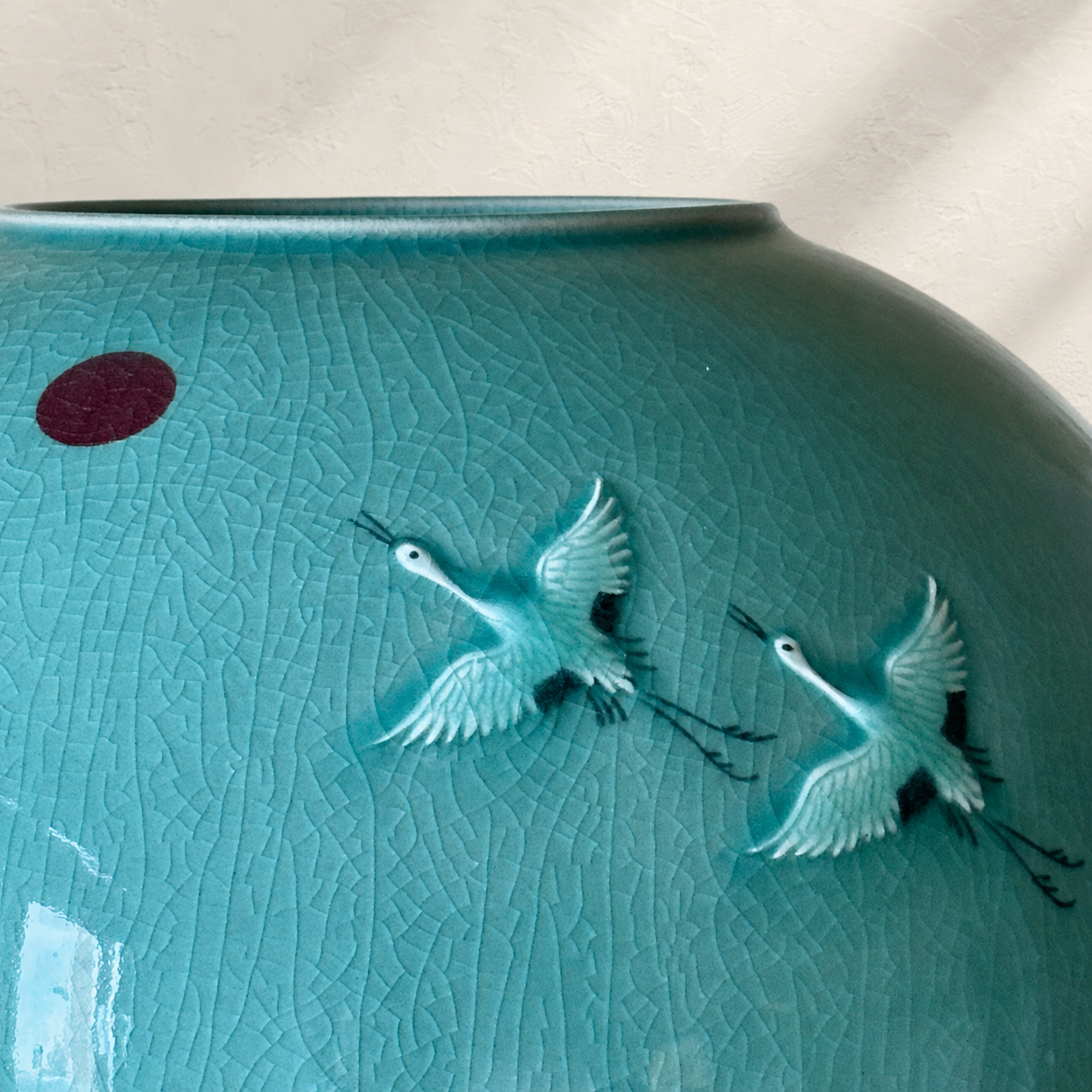
The two cranes occupy only a small portion of the body. This asymmetry is essential. Had they been enlarged or centrally positioned, they would have dominated the vessel as an illustration. Instead, they appear to cross an already existing expanse. The celadon surface precedes them and continues beyond them. Their flight is therefore understood through the surrounding space as much as through their own modelling.
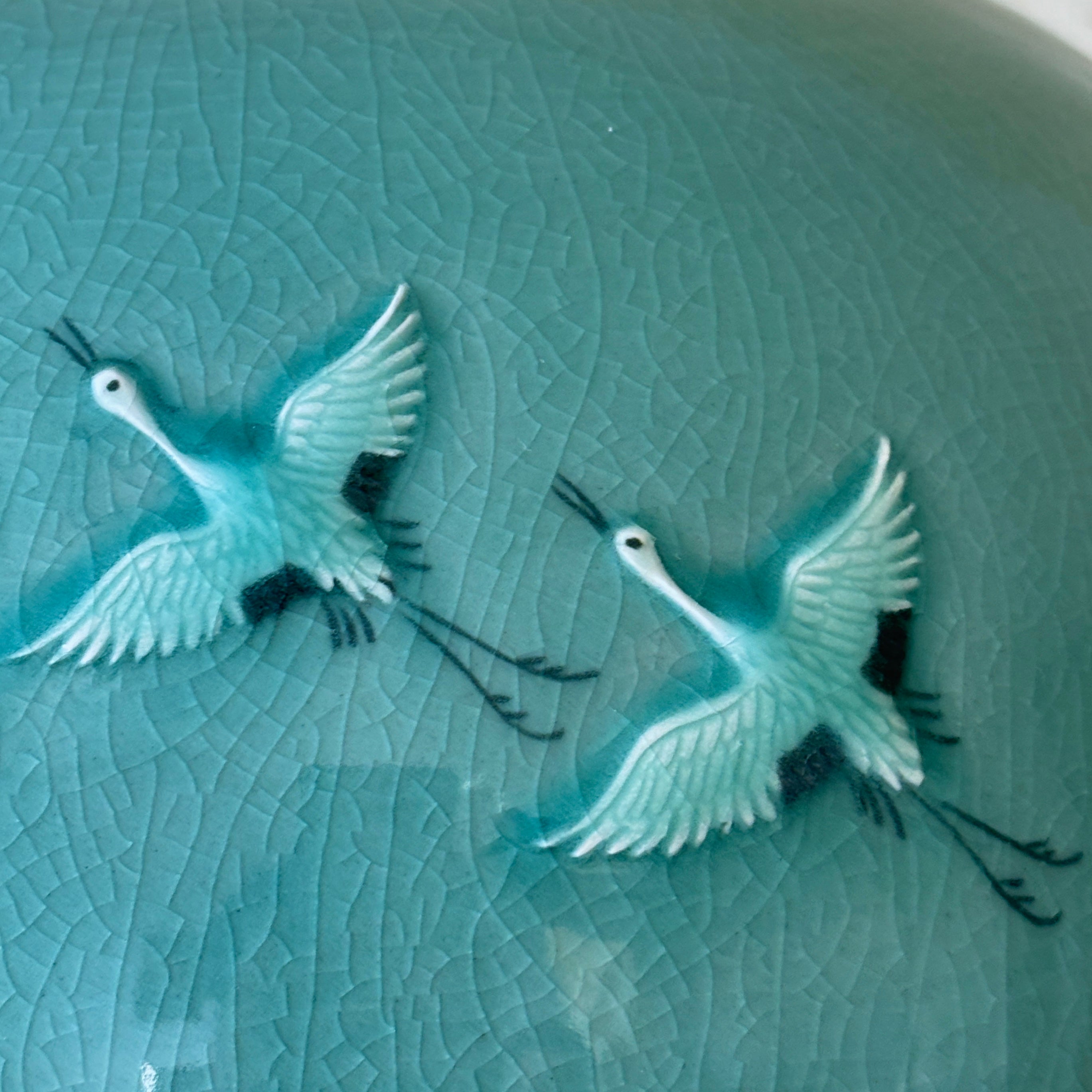
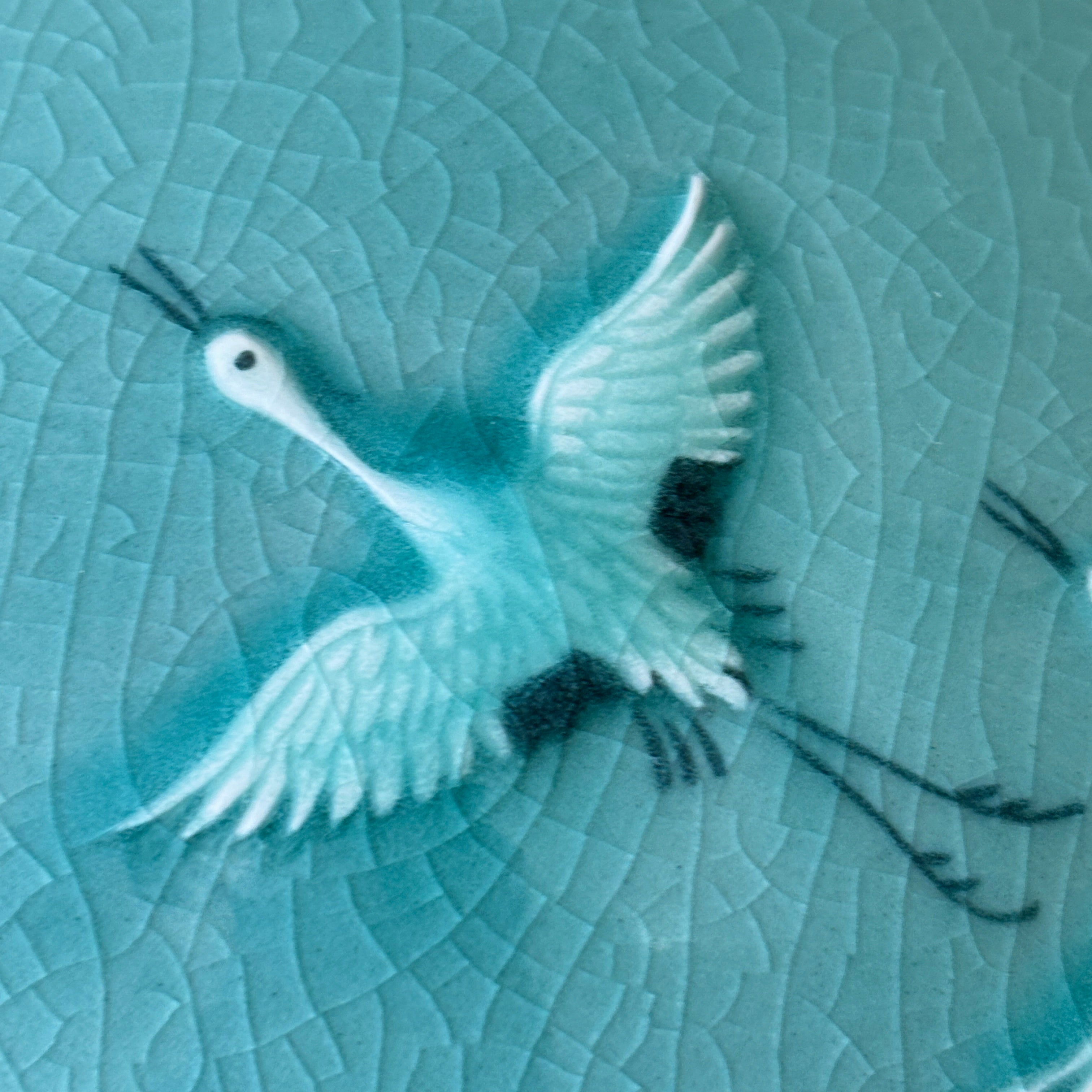
The cranes are formed in raised relief, lifting slightly from the blue-green ground. Their white bodies create immediate contrast, while the darker accents in their feathers, beaks, and trailing legs preserve a sense of graphic precision. The relief is controlled rather than heavily sculptural. It provides enough projection for the birds to catch light and cast shadow, but not so much that they separate from the curvature beneath them.
Their positions establish a subtle sequence. One crane advances slightly ahead, while the second follows in close relation. The pair therefore suggests companionship without static symmetry. They are joined by direction rather than by identical posture. This distinction gives the scene emotional restraint: the relationship is visible, but it is not overstated.
In Korean culture, the crane has long carried associations with longevity, dignity, spiritual elevation, and the cultivated life. As a pair, the birds can also evoke fidelity, harmony, and the continuation of a shared path. Kim’s composition avoids placing these meanings within an elaborate landscape. By removing trees, mountains, and architecture, he isolates the essential relationship between the two figures.
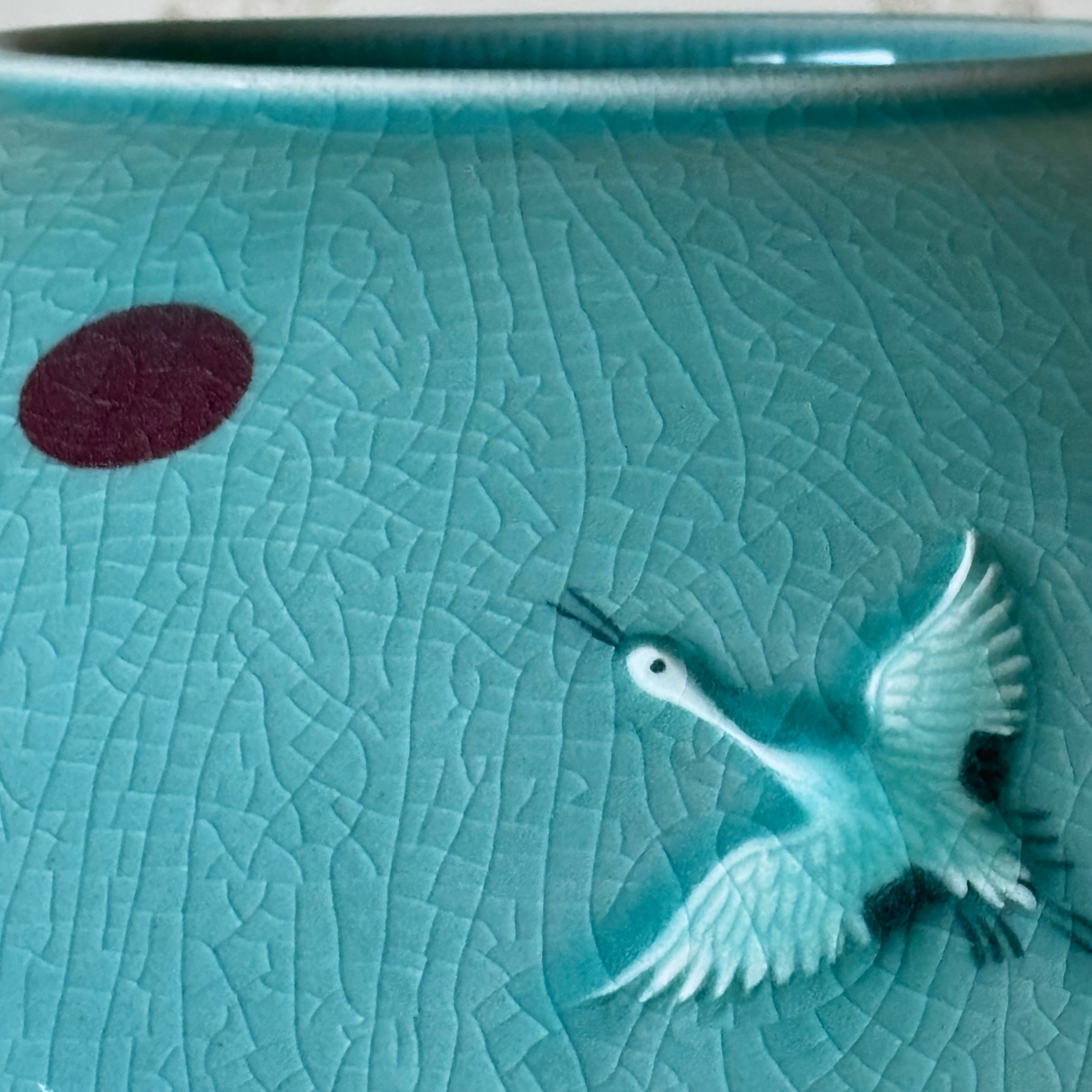
The red sun alters the entire reading of the composition. Its scale is small, yet its colour gives it considerable authority. Placed apart from the cranes, it establishes a triangular relationship among the two birds and the circular red form. The eye moves from the sun towards the cranes, then outward across the unoccupied glaze. This arrangement gives direction to an otherwise seamless spherical body.
The sun also introduces time. Without it, the cranes might appear suspended in an abstract celadon field. With it, the field becomes atmospheric: a dawn sky, an auspicious beginning, or a moment of passage under enduring light. In Korean symbolic imagery, the sun may be understood as a sign of life, renewal, constancy, and ordered continuity. Here, it does not overwhelm the scene. It remains a single measured presence.
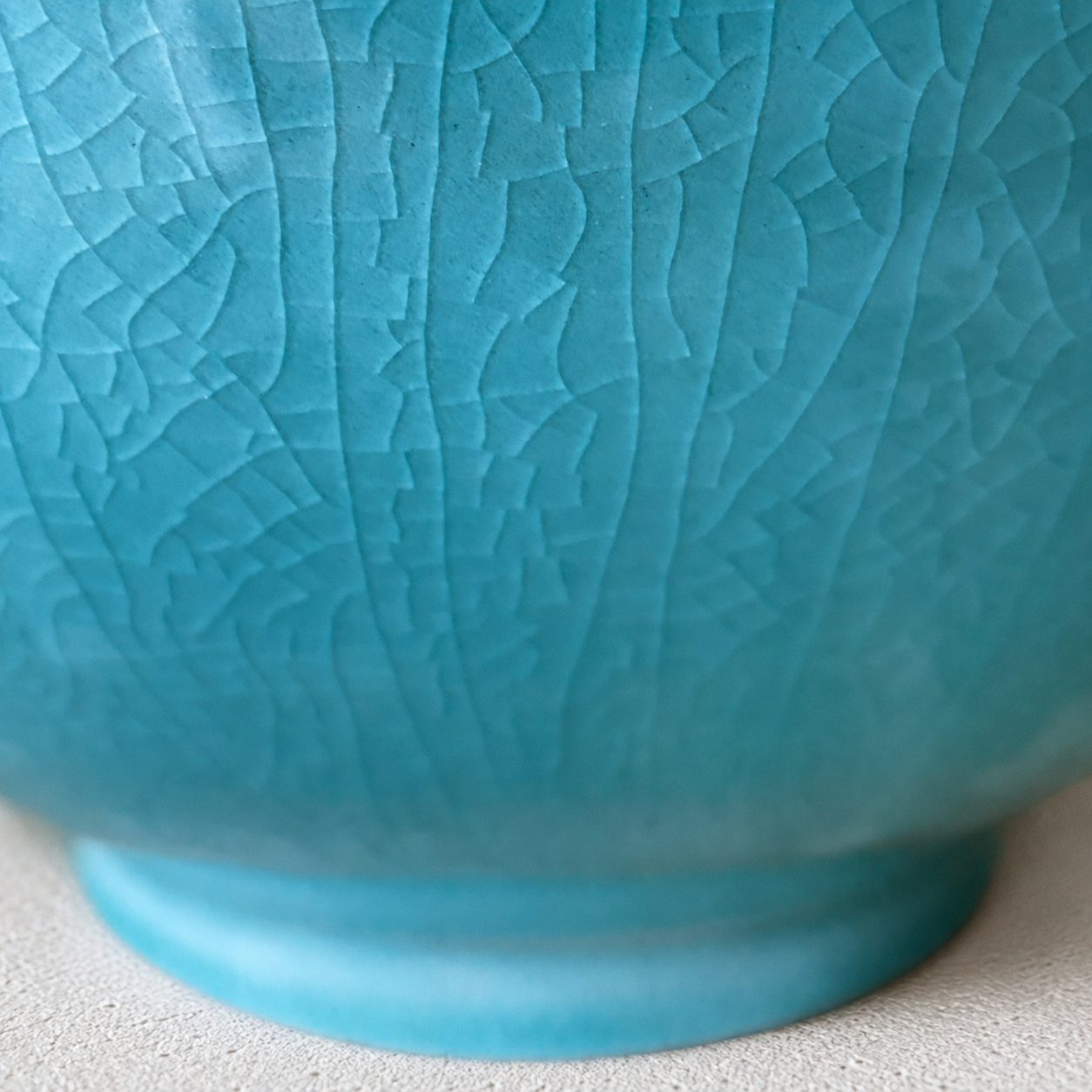
The glaze serves as more than colour. Its luminous blue-green tone gives the spherical body a depth that shifts according to illumination. The fine crackling spreads across the surface like a secondary drawing, quieter than the cranes and sun but active throughout the vessel. These lines prevent the open areas from becoming visually blank. They allow the apparently undecorated field to remain alive.
This relationship between crackle and relief is particularly important. The crackling belongs to the surface itself, while the cranes rise above it. One is dispersed and continuous; the other is concentrated and figurative. The red sun, meanwhile, operates as a flat chromatic mark. Three distinct visual languages therefore coexist: the network of the glaze, the physical projection of the cranes, and the concentrated circle of colour.
The spherical body rewards movement around the piece. From the front, the birds and sun form a contained scene. Seen from an angle, the cranes begin to follow the curvature and appear to move away from the viewer. As the vessel is turned further, the motif recedes and the celadon field takes precedence. The object therefore shifts between image and pure form.
What distinguishes the work is not simply its minimal decoration, but the precision with which that restraint has been structured. The sun is small because its colour already carries weight. The cranes are raised only enough to become present. The surrounding field is left open because the composition depends upon distance.
The vessel does not present emptiness as lack. It presents space as the place in which movement, companionship, and renewal become legible. The two cranes pass; the red sun remains; the rounded celadon body holds both transience and continuity within a single, sustained form.
Dimension
- Diameter- 32 cm (9.05 inch)
- Height- 30cm (12.6 inch)
Choisir les options