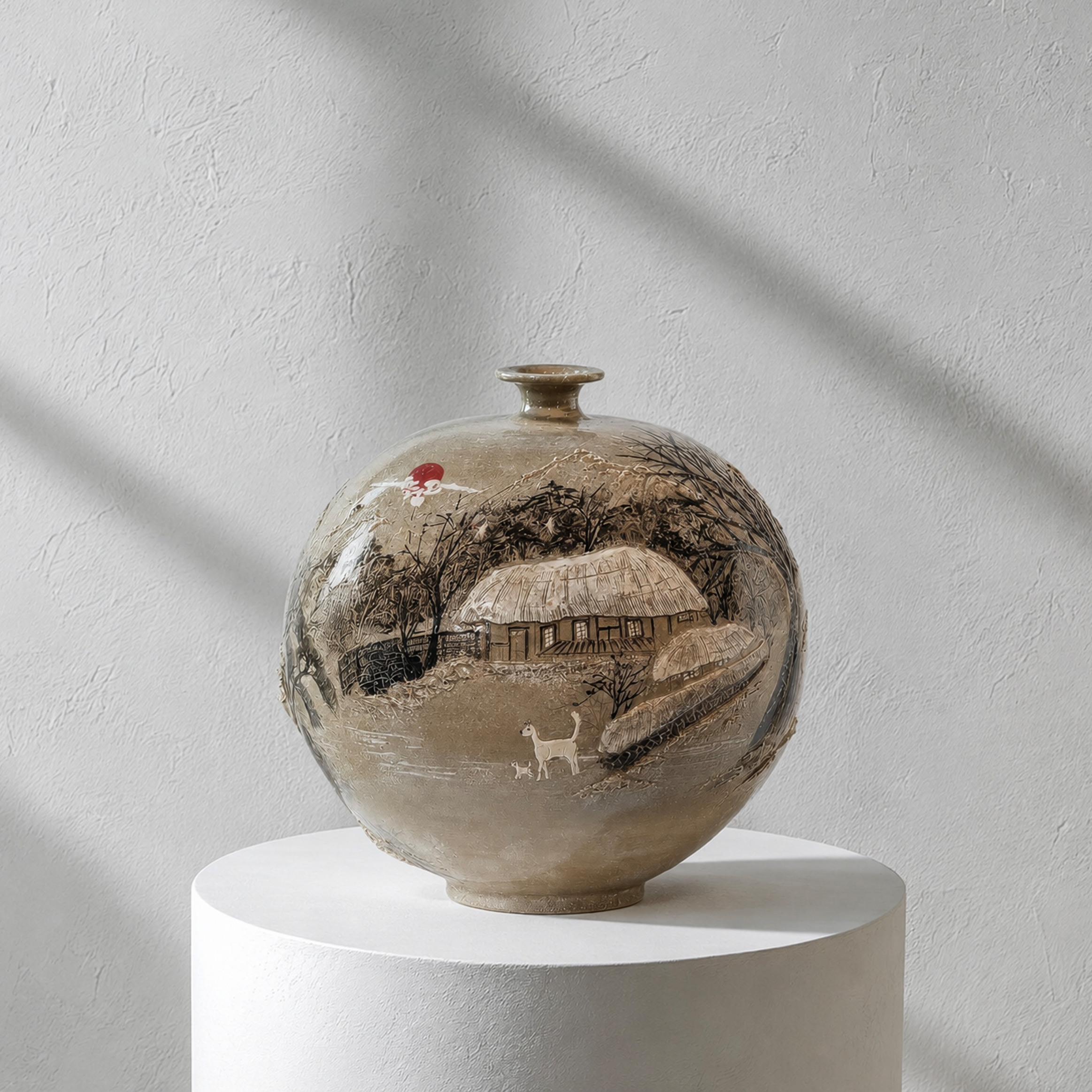
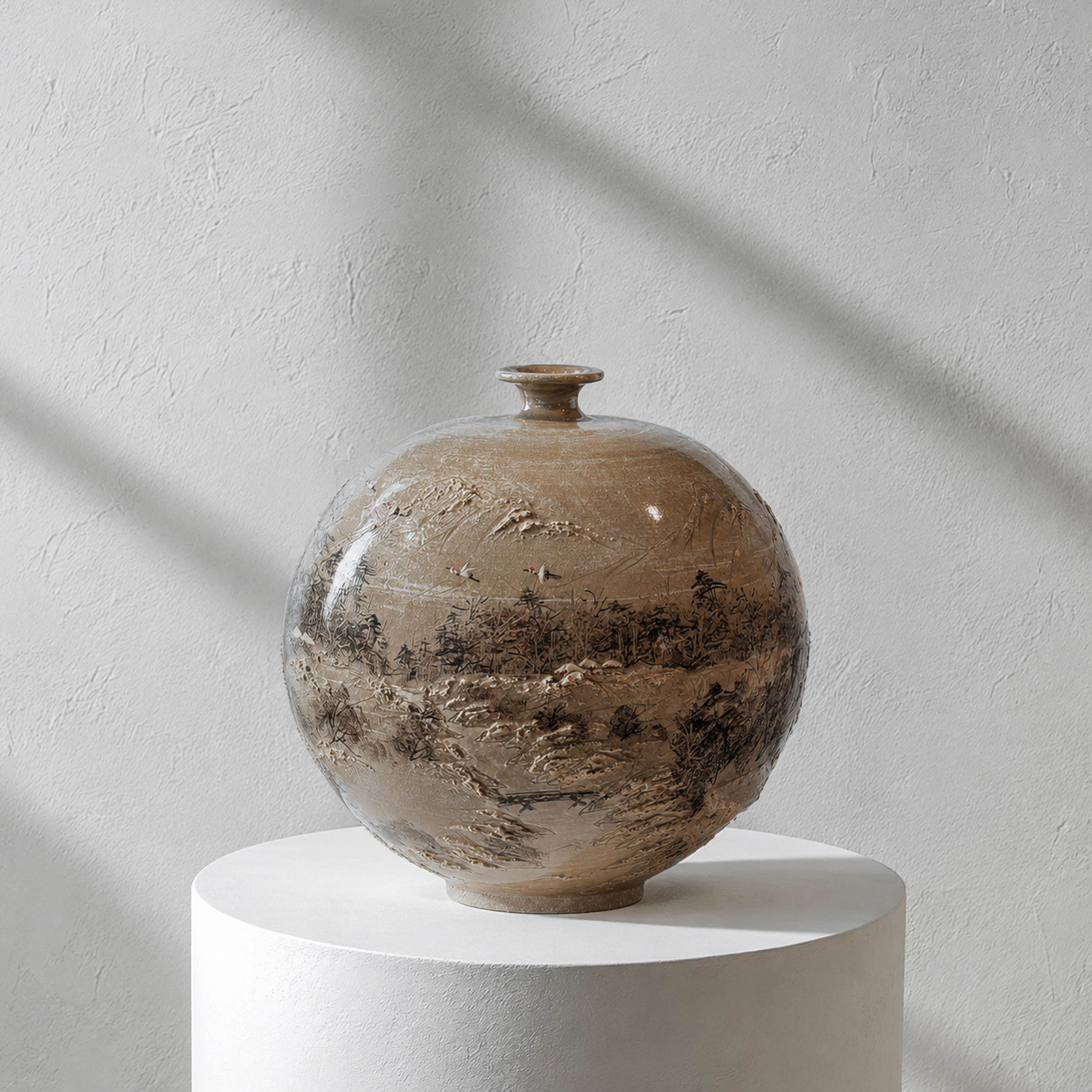
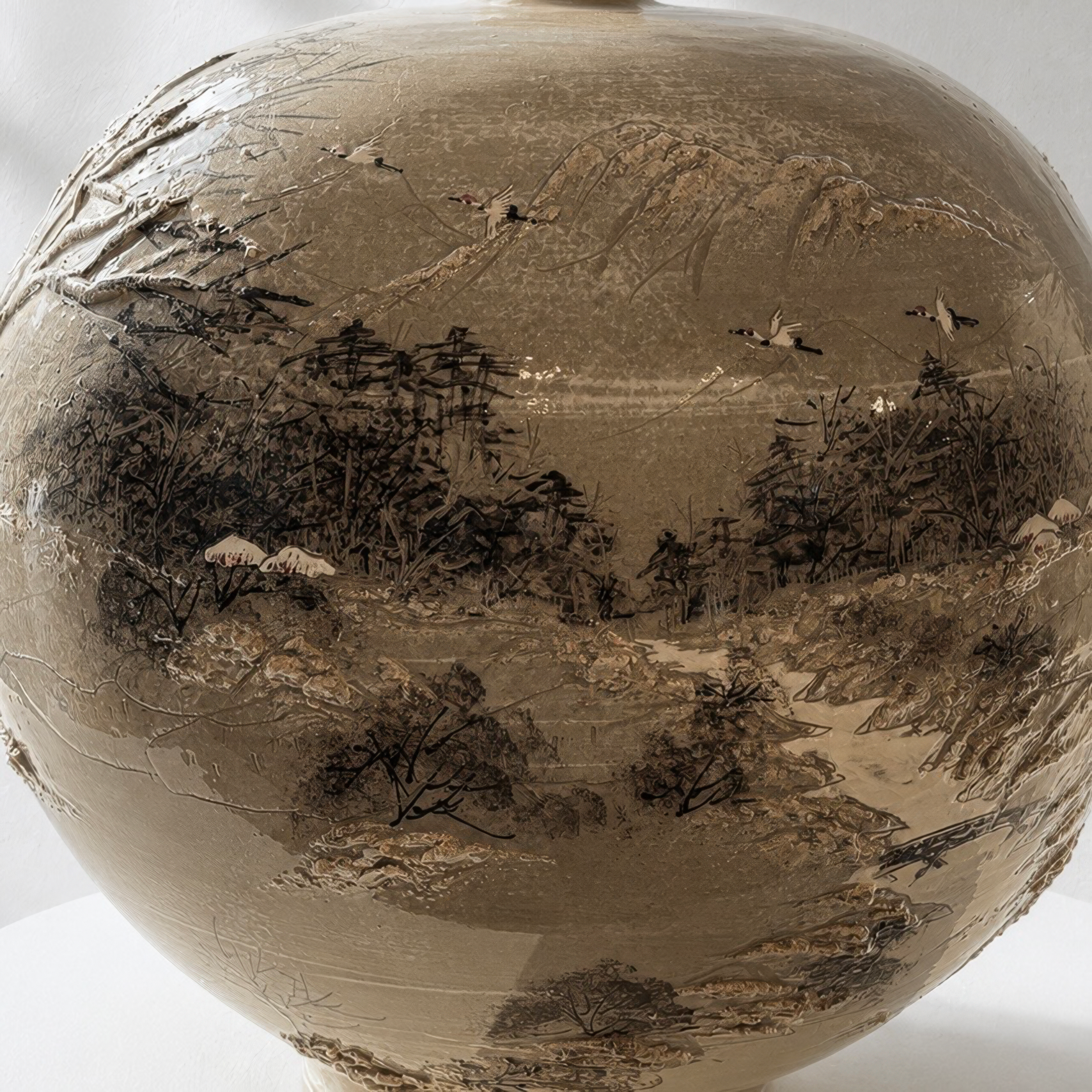
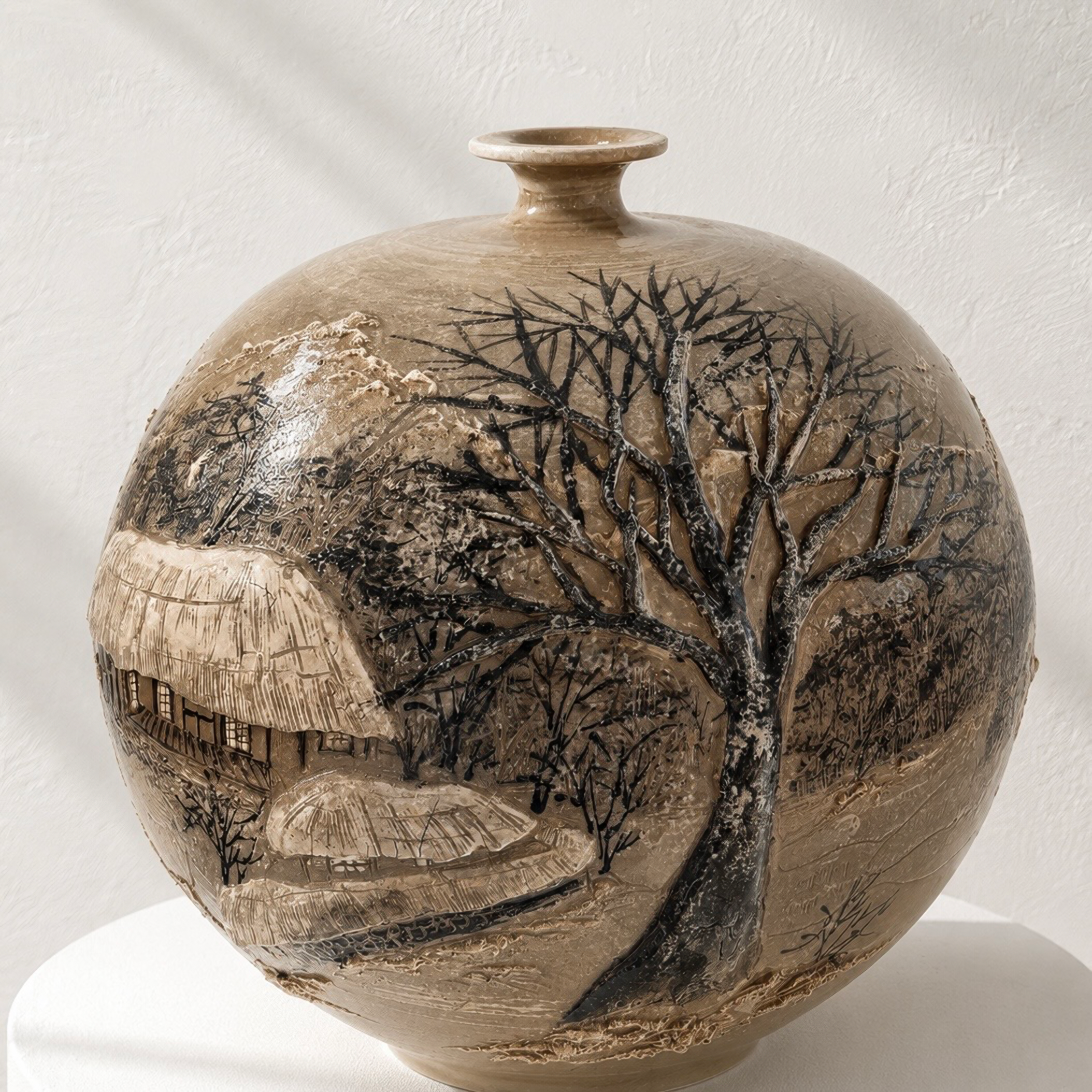
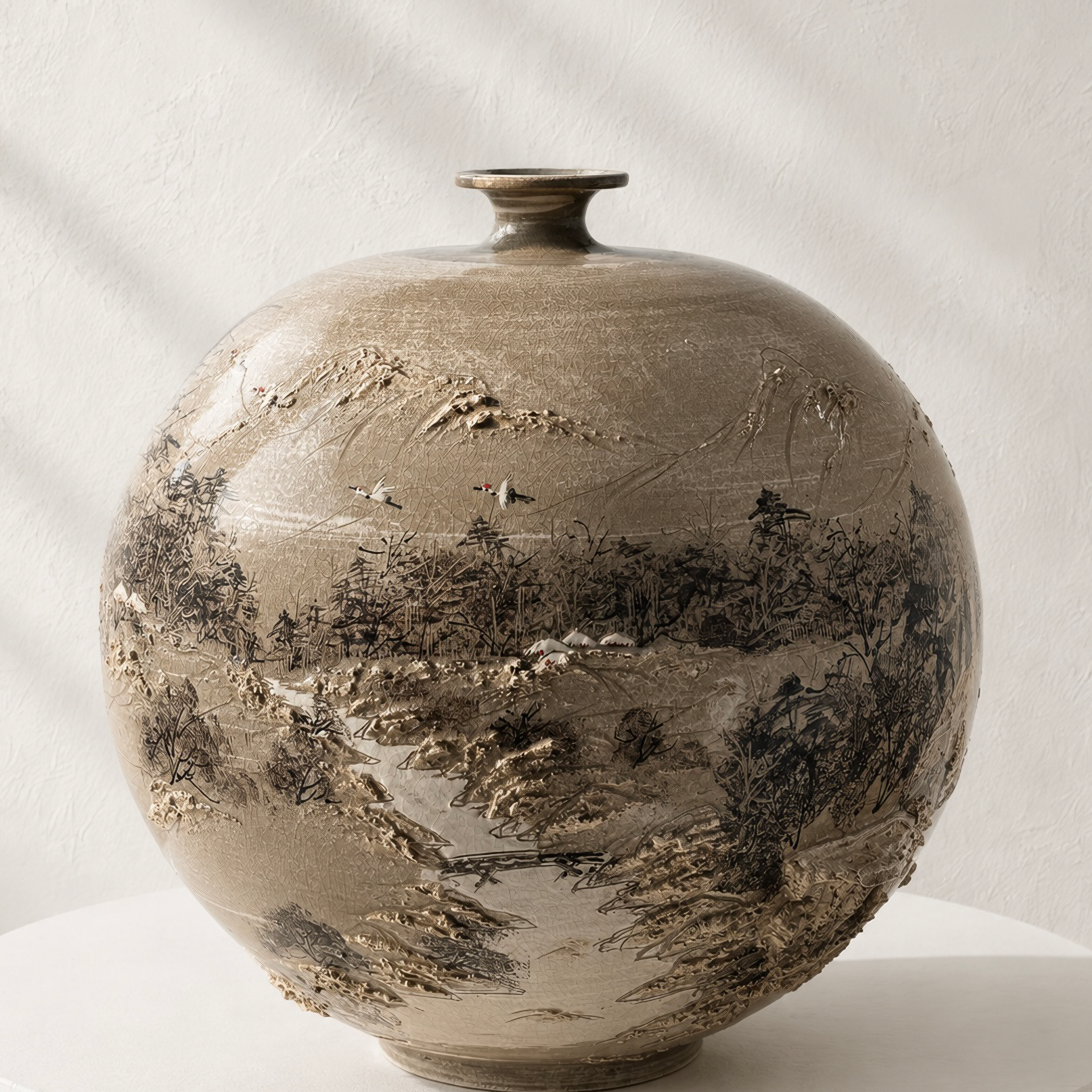

Buncheong Vessel (Ho): Thatched-House Landscape in Applied Relief, 2023
This work brings together material directness and emotional resonance with remarkable clarity, using the language of Buncheong to evoke not an idealized landscape, but a lived and remembered Korean world.
“On this vessel, the surface becomes a place of return—a terrain where memory, touch, and vernacular life converge.”
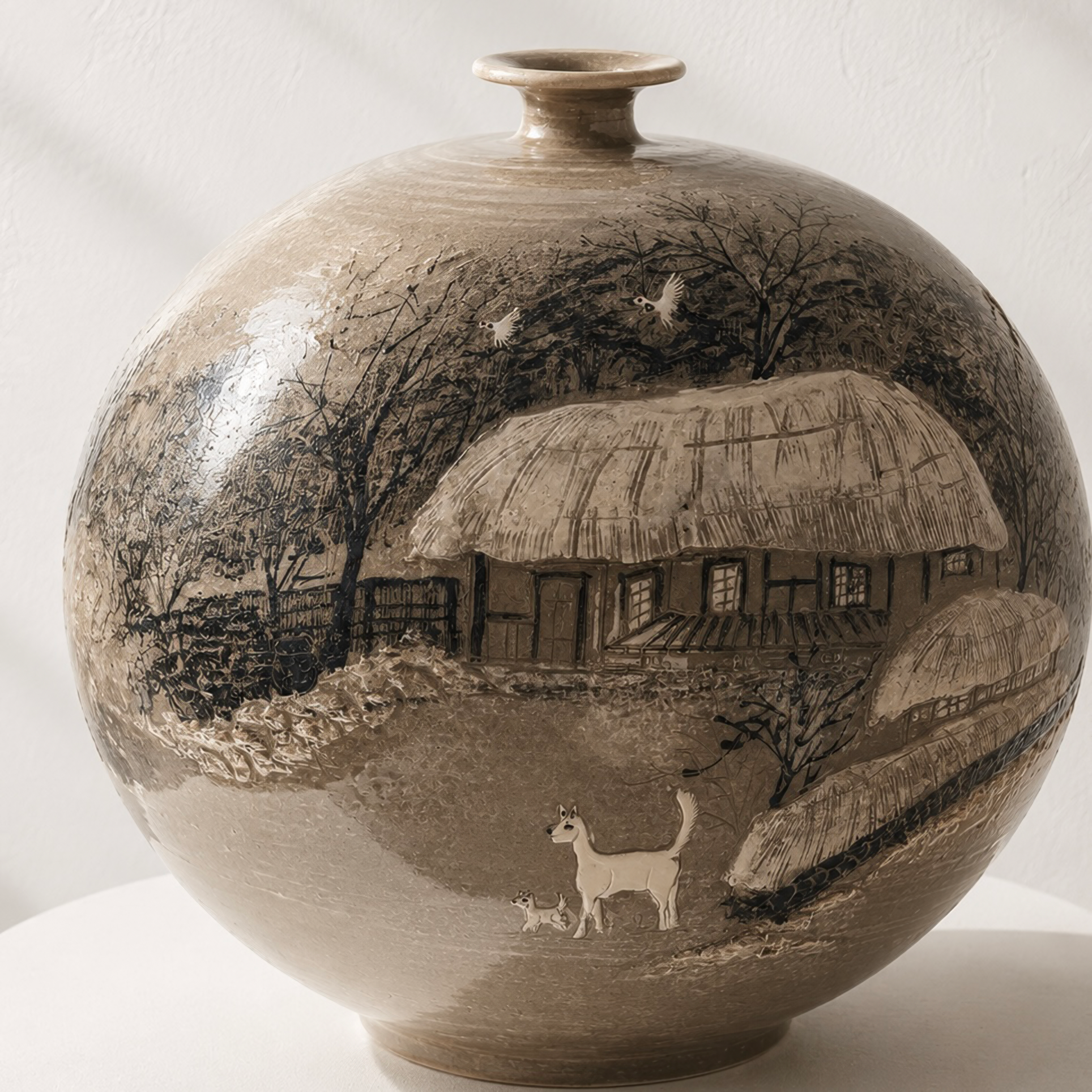
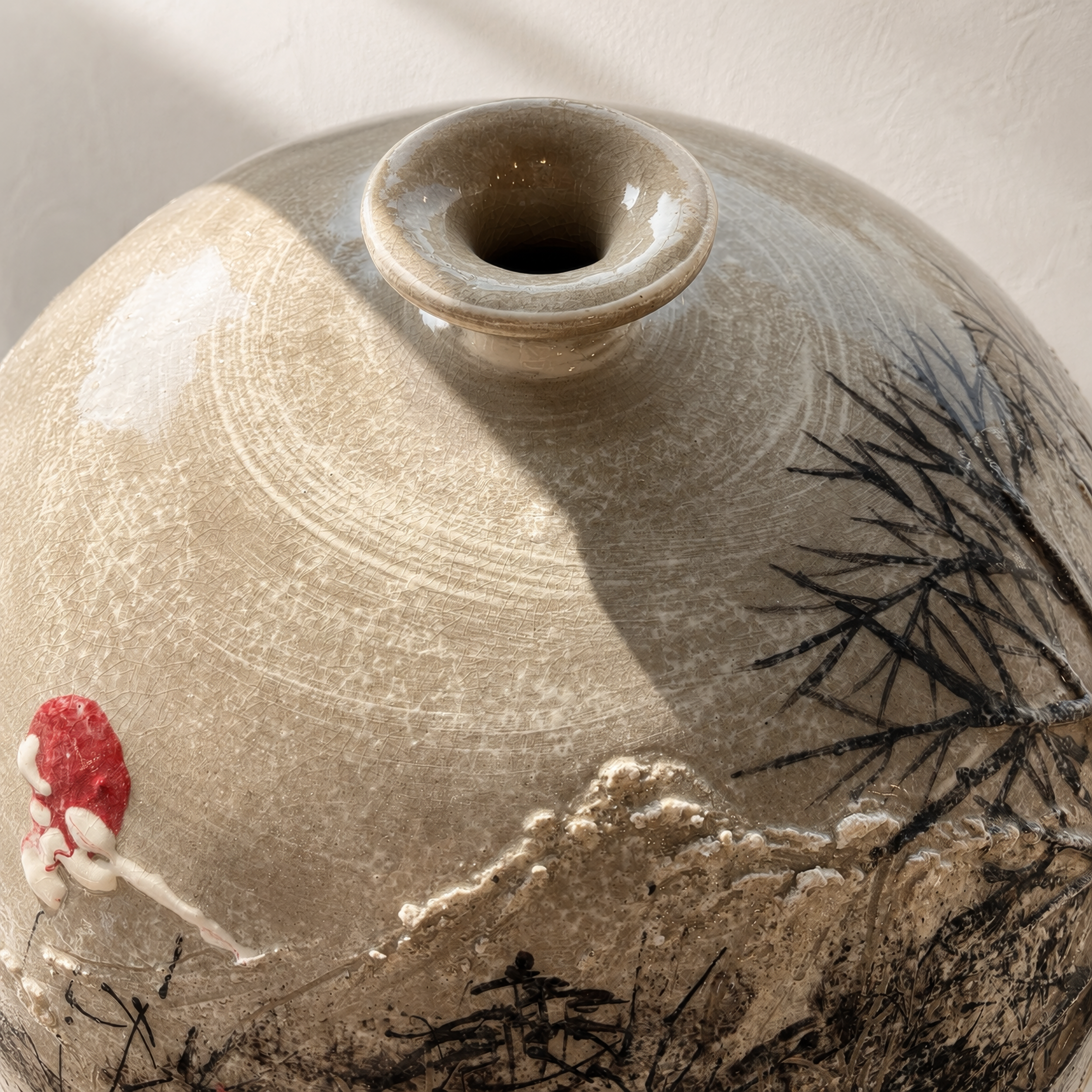
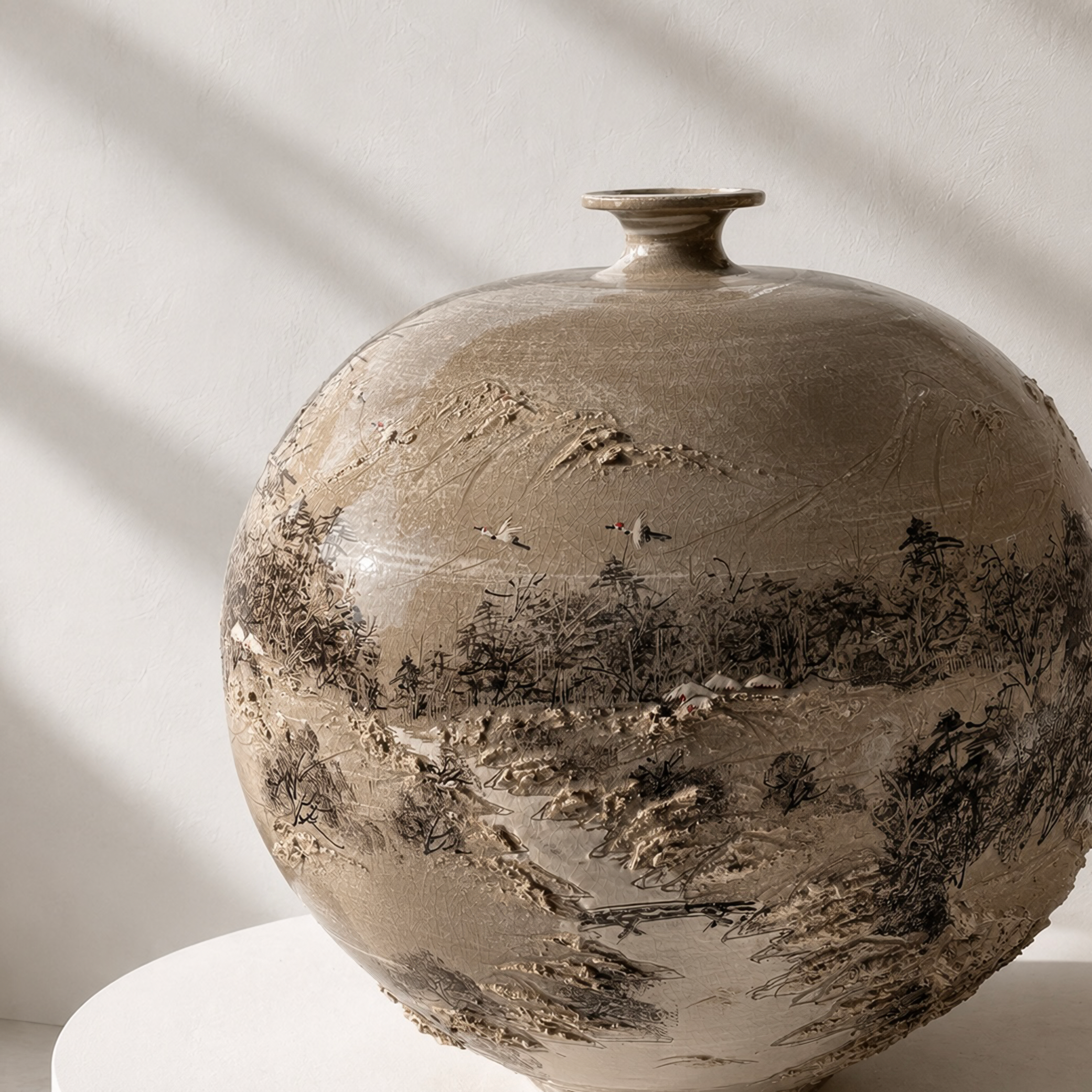
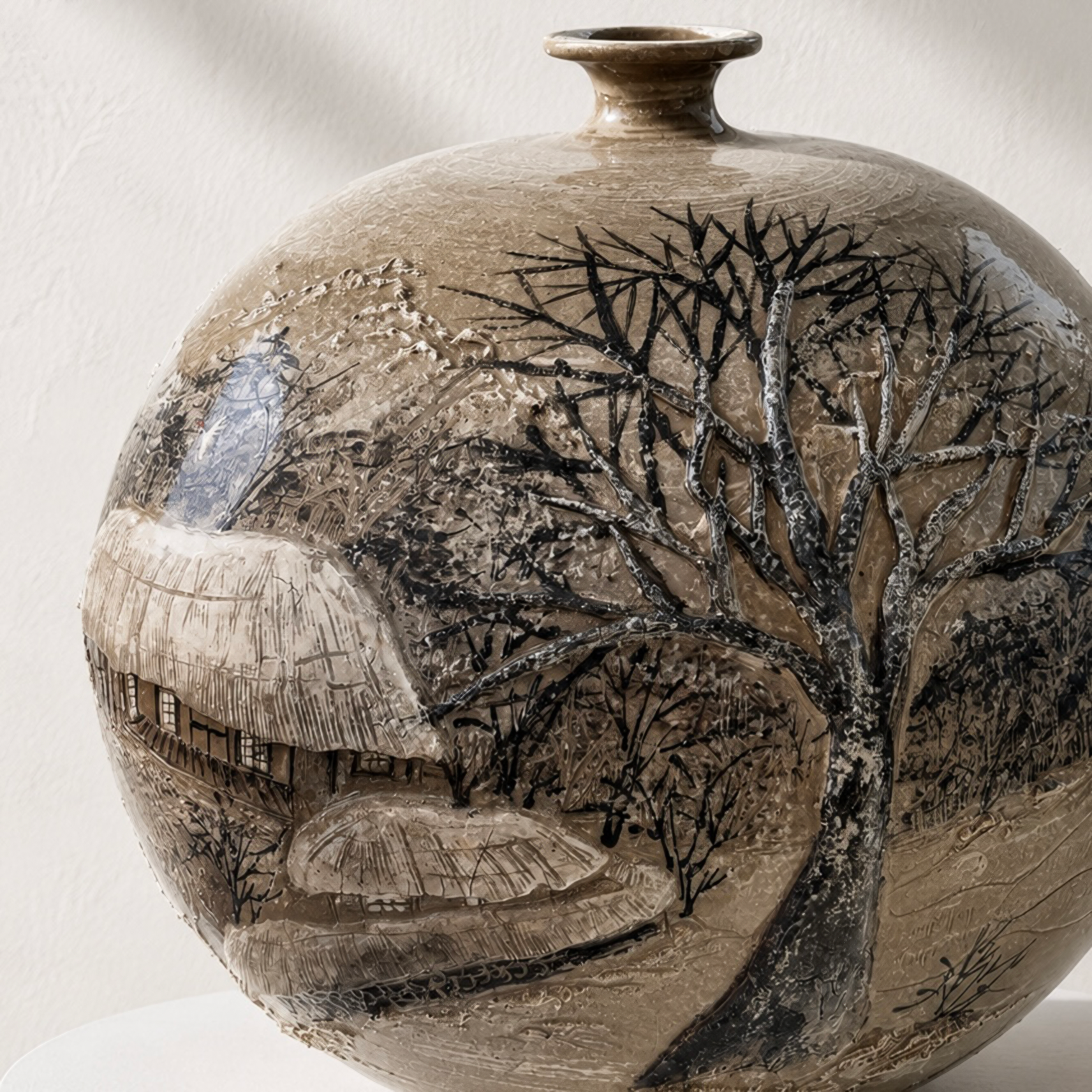
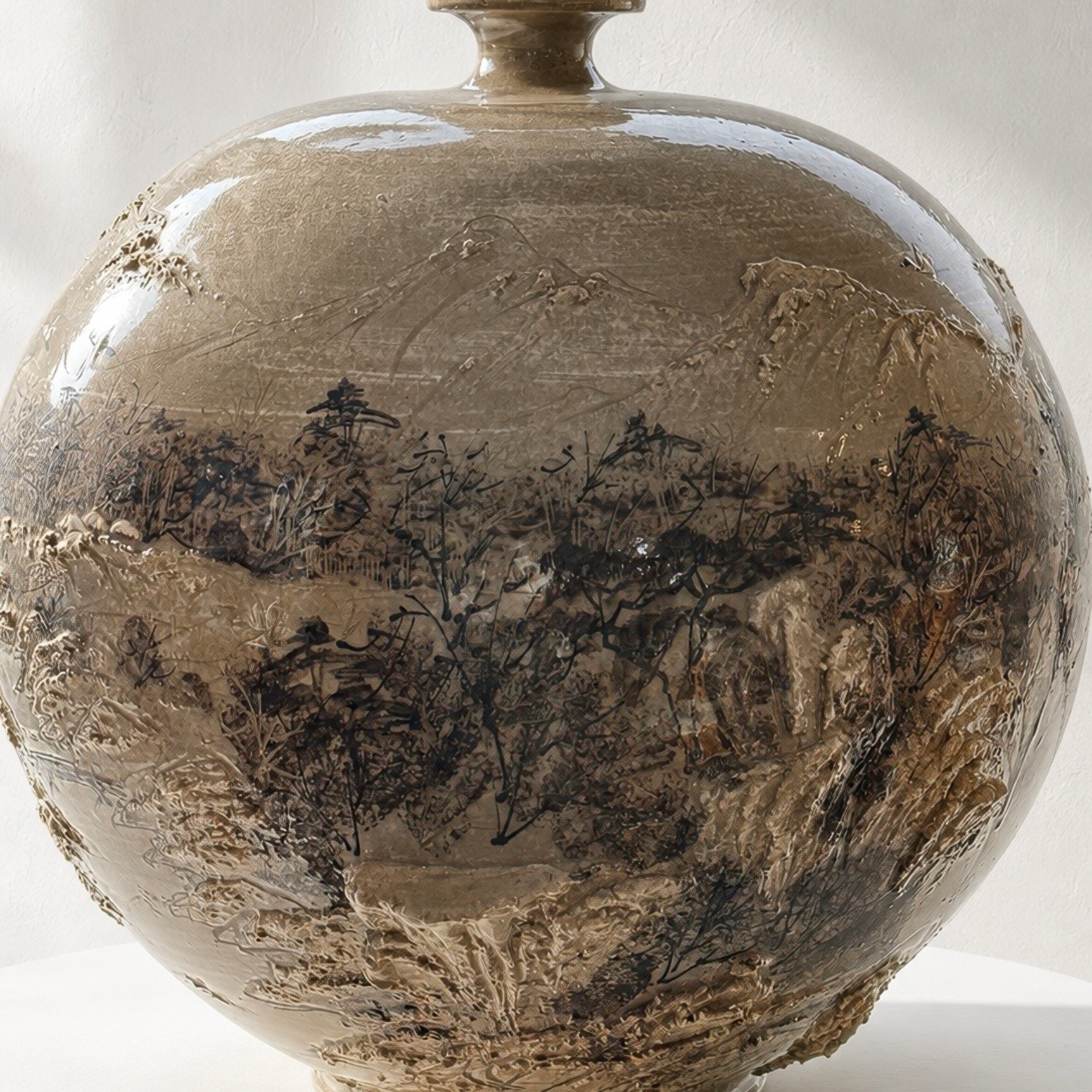
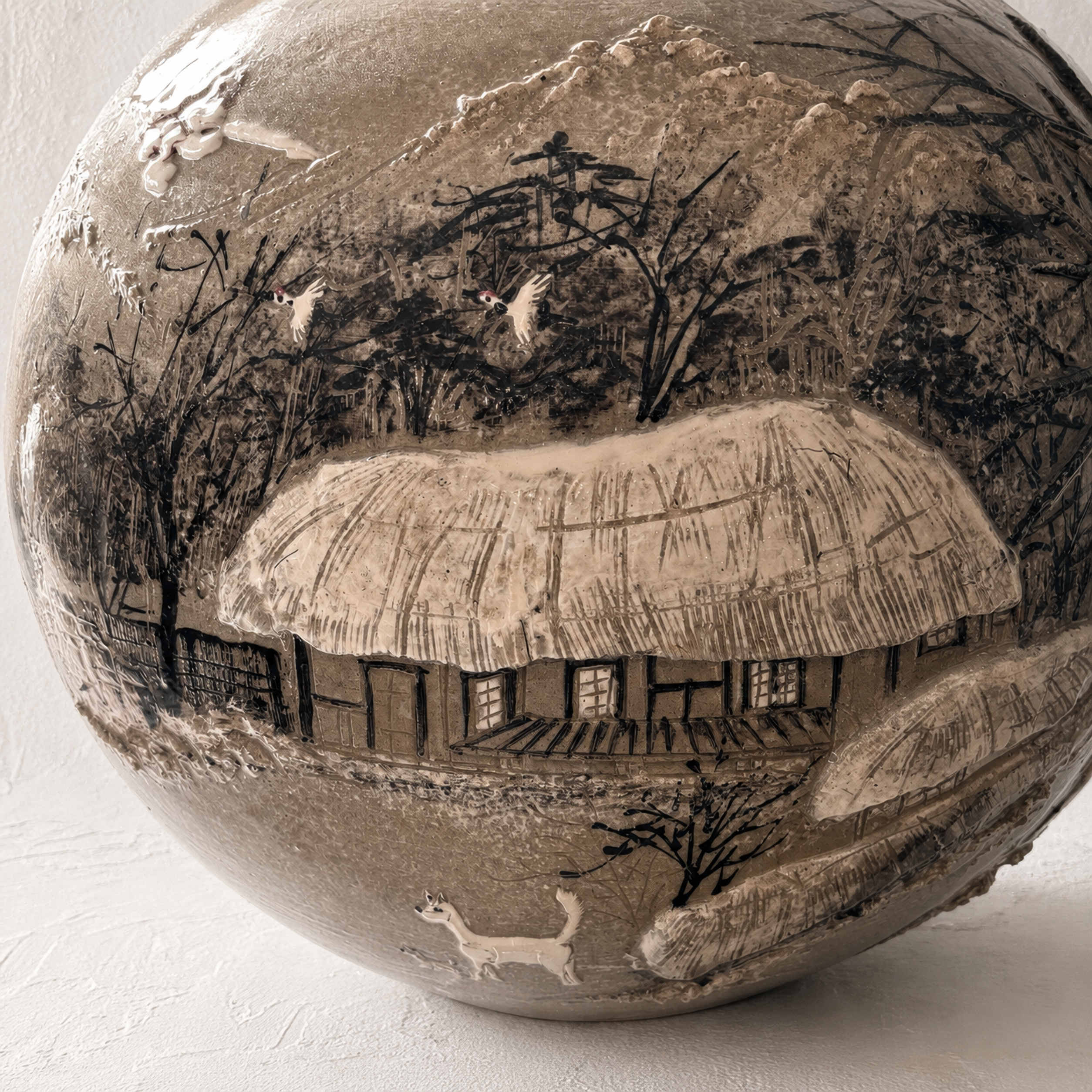
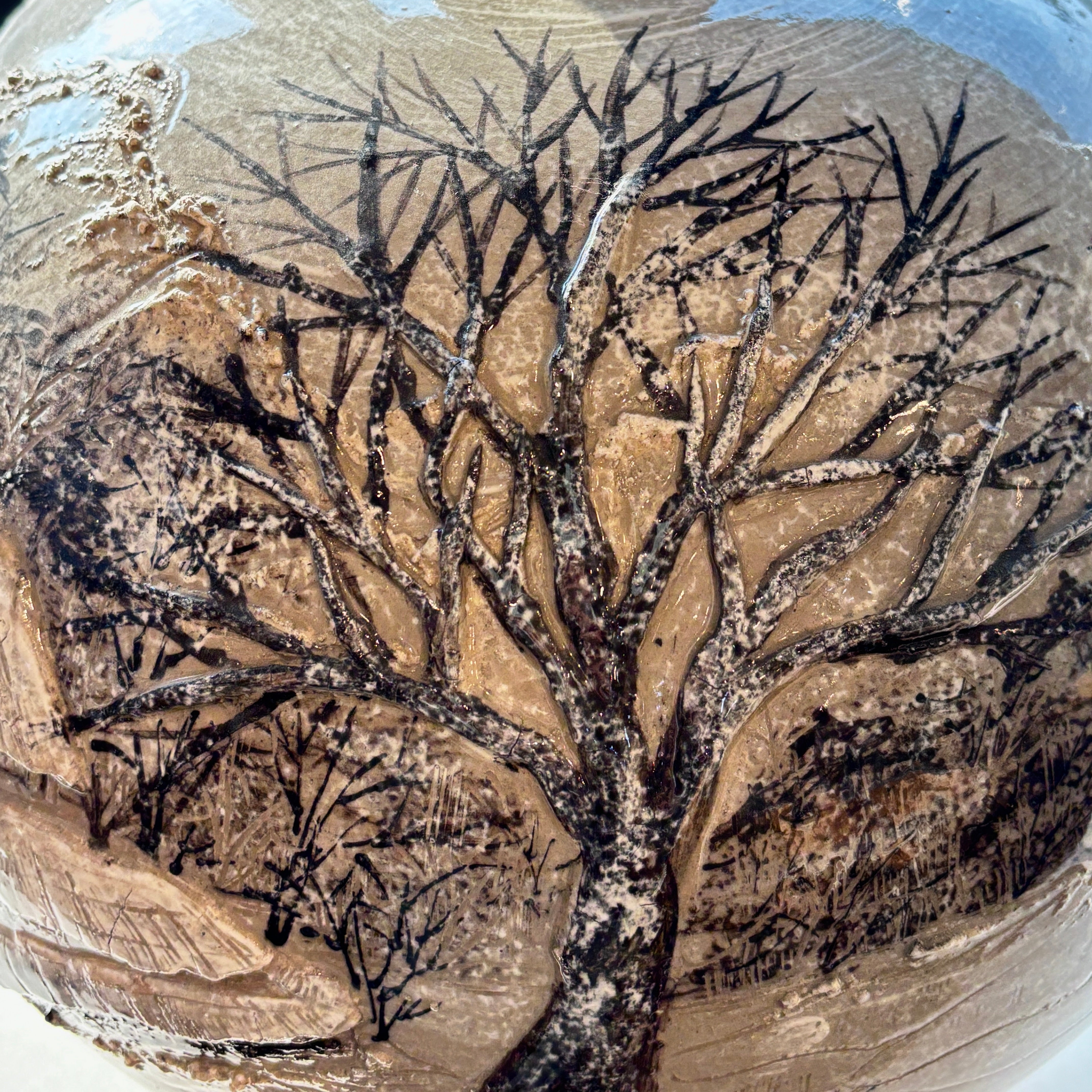
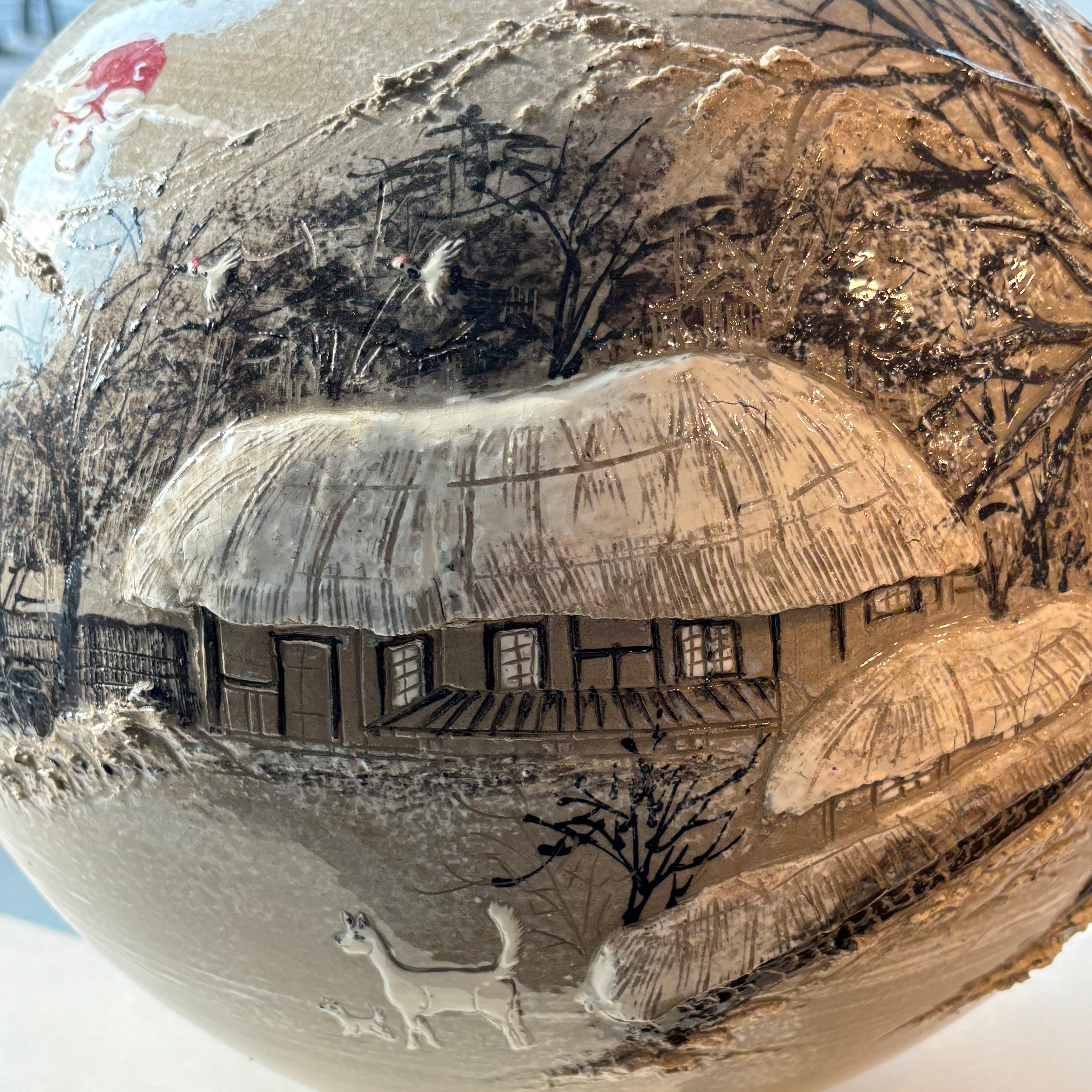
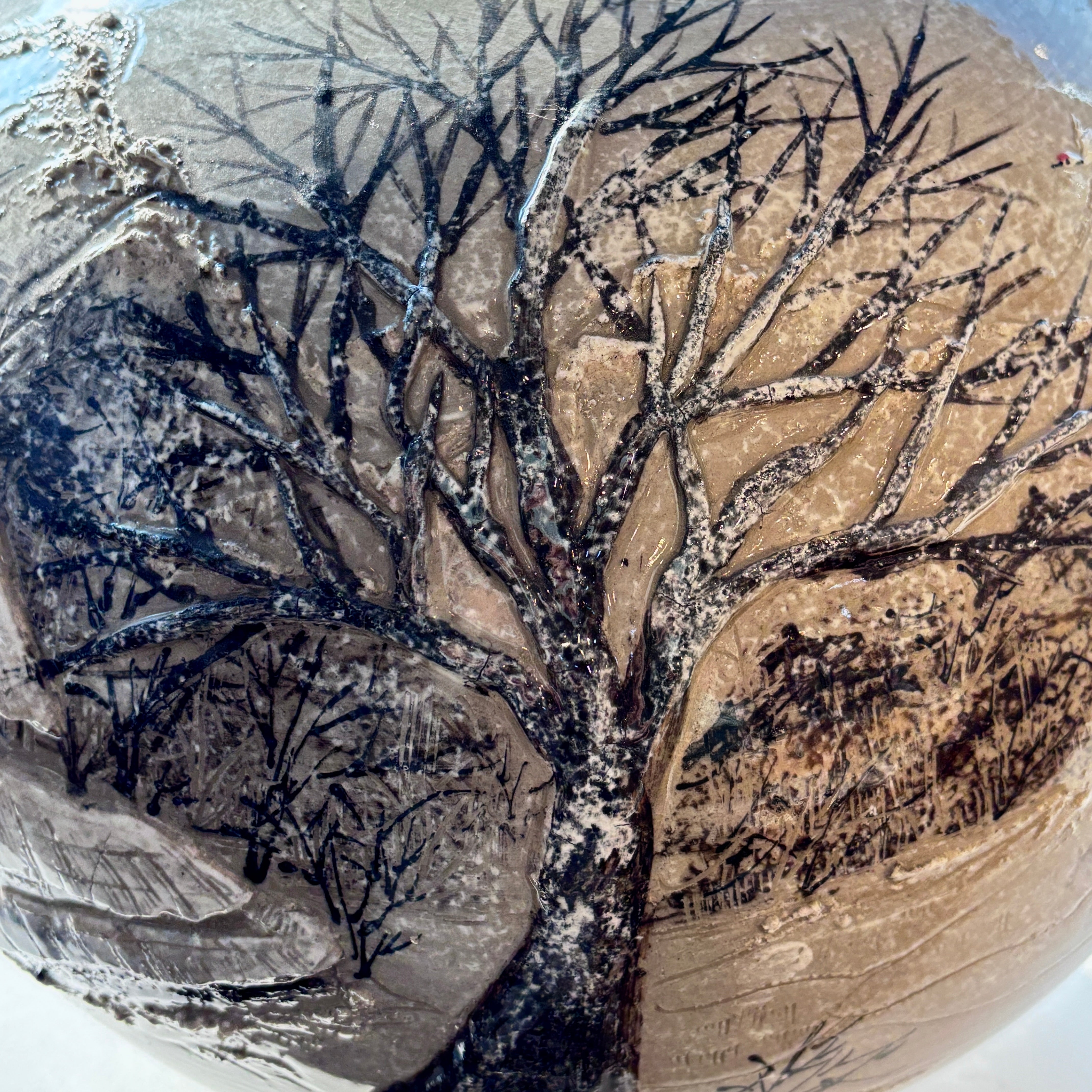
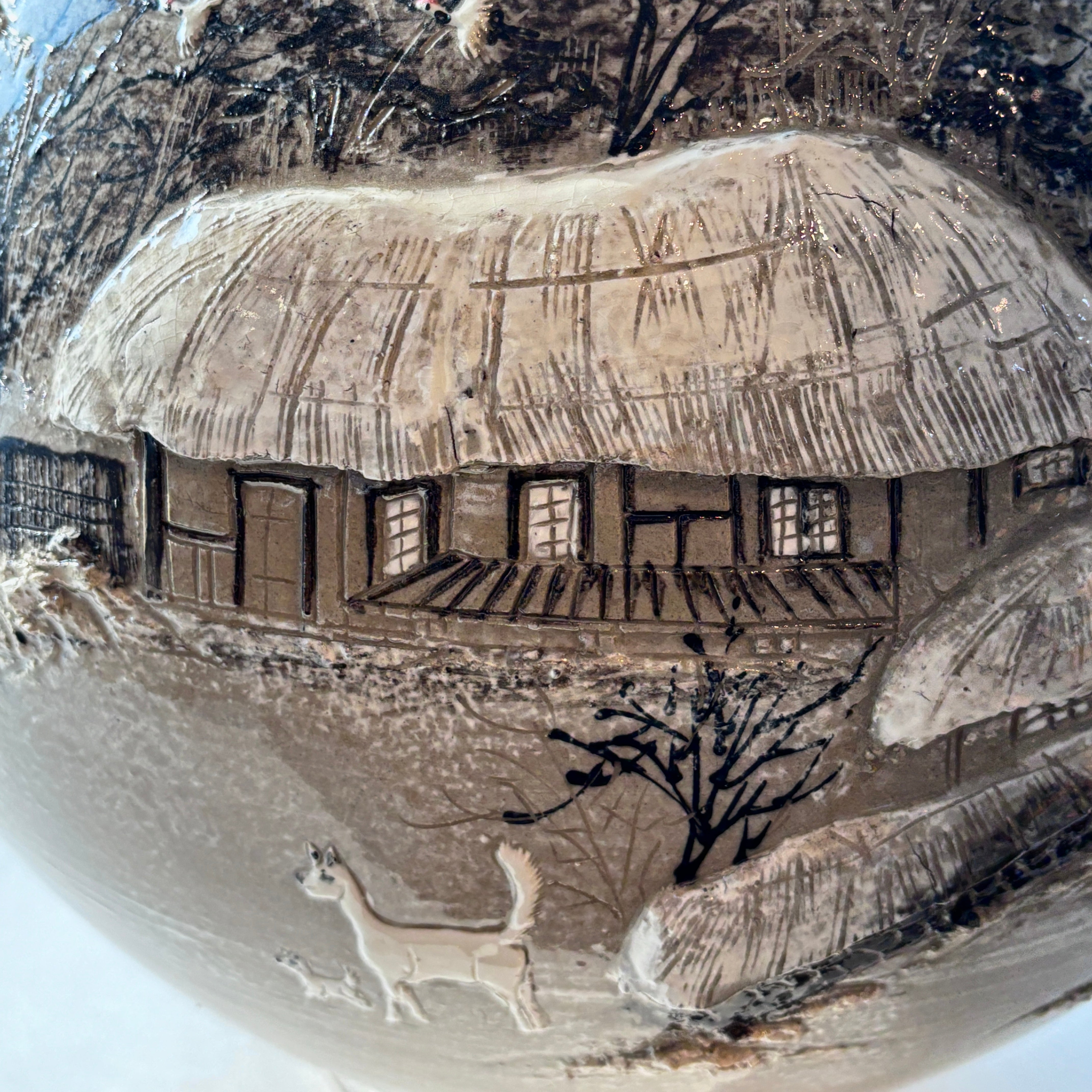
Created by Kwon O Hak, an Icheon master ceramic artisan, this Buncheong vessel (ho) is distinguished by its use of the applied-relief technique to render a rural landscape in three-dimensional form. Rather than relying on painted illusion alone, the artist constructs the imagery physically on the vessel’s exterior, allowing the thatched-roof house, stone walls, trees, and surrounding terrain to rise gently from the body. The landscape is therefore not simply depicted; it is materially embedded into the structure of the work.
At the center of the composition is the image of the thatched house, a motif carrying profound cultural and emotional weight within Korean visual memory. It evokes not only a rural dwelling, but an entire sensibility—one shaped by humility, kinship, and an unforced closeness to the natural environment. The scene does not strive for spectacle. Instead, it articulates a specifically Korean ideal of quiet endurance and unadorned peace. The low walls, softened paths, and organic contours of the landscape contribute to this atmosphere of intimacy and repose.
The choice of Buncheong ware is especially significant. Buncheong has long been valued for its spontaneous, earthy, and unpretentious character. In this work, the medium’s warm, subdued tonality and slightly rugged softness allow the vessel to resist polish in favor of presence. The surface retains an immediacy that supports the subject matter: a rural world that feels close, tactile, and human. This is Korean naturalism not as abstraction, but as a felt relationship between material, place, and memory.
The rounded form of the vessel plays an important role in the reading of the work. Its generous volume provides a continuous field across which the landscape can unfold, while also reinforcing the sense of containment—as though the scene were held in a sphere of recollection. The viewer does not encounter a single frontal image alone, but rather a landscape that wraps around the body, encouraging slow movement and sustained looking. In this sense, the work is experienced both as sculpture and as narrative surface.
From a technical standpoint, the piece represents a high level of difficulty. The applied-relief method requires clay elements to be added onto a curved surface, yet those additions must endure the drying and firing process without separating from the body. Because the shrinkage rates of the base form and applied motifs may differ, the risk of cracks, warping, or detachment is considerable. On a large rounded vessel, these challenges intensify further: the form must retain equilibrium, and the relief must fuse completely with the body under kiln conditions. Such works are therefore rare not simply because of their decorative complexity, but because of the profound technical discipline required for successful completion.
This vessel ultimately succeeds because it balances difficulty with restraint. Its achievement lies not in excess, but in atmosphere: the transformation of clay into a vessel of memory, and of a rural scene into a meditation on the values of simplicity, belonging, and peace. It is an object of considerable craftsmanship, but also one of emotional intelligence—quietly carrying the image of a homeland across its curved and earthen skin.
Dimensions
- Diameter- 34cm (13.39 inch)
- Height- 35cm (13.78 inch)
Choose options