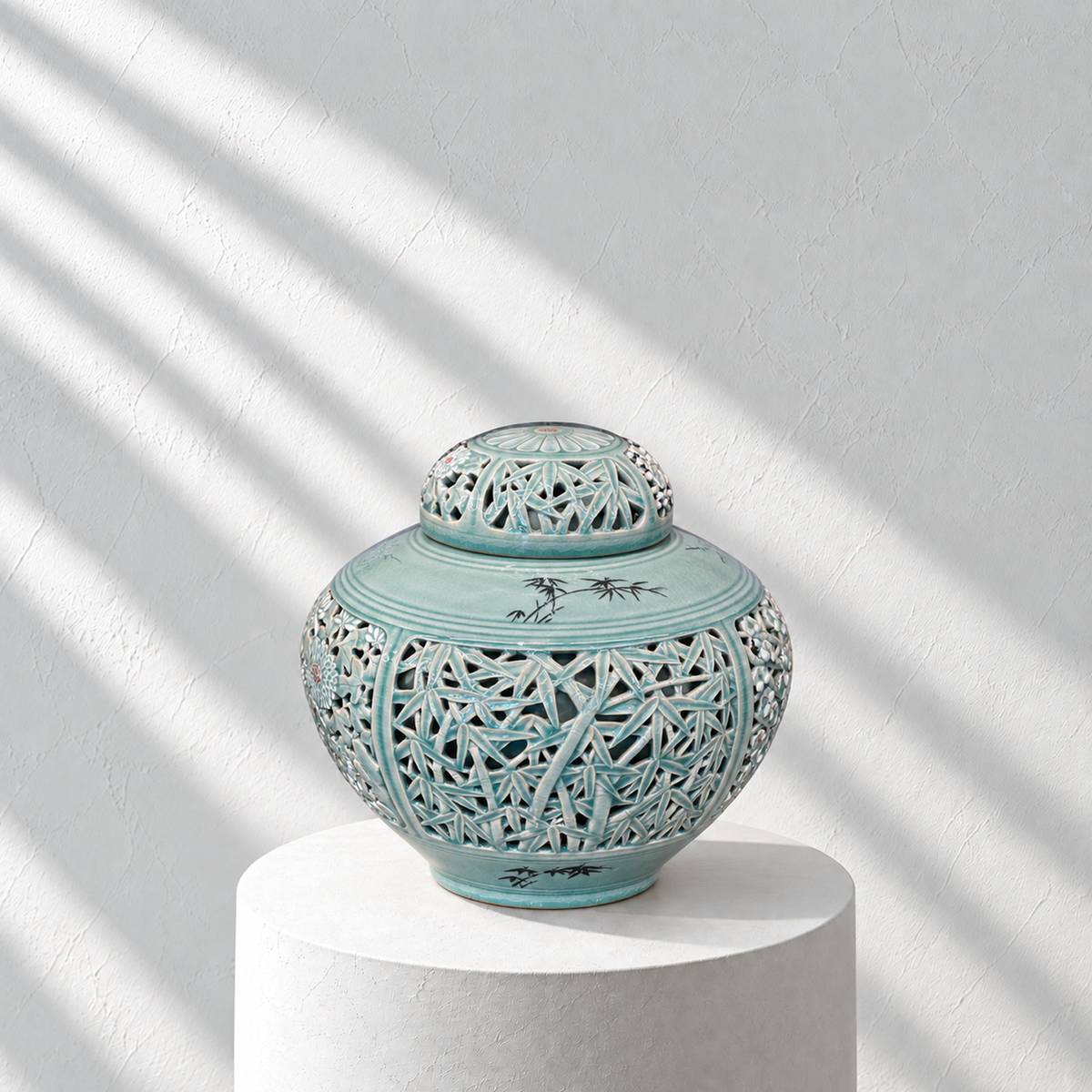

Celadon Double-Walled Openwork Lidded Jar: Four Gracious Plants Motif, 2021
Those who choose this piece are often attentive to objects whose complexity reveals itself through repeated looking rather than immediate spectacle.
"The vessel does not illustrate the Four Gentlemen at once; it asks the viewer to meet them one by one."
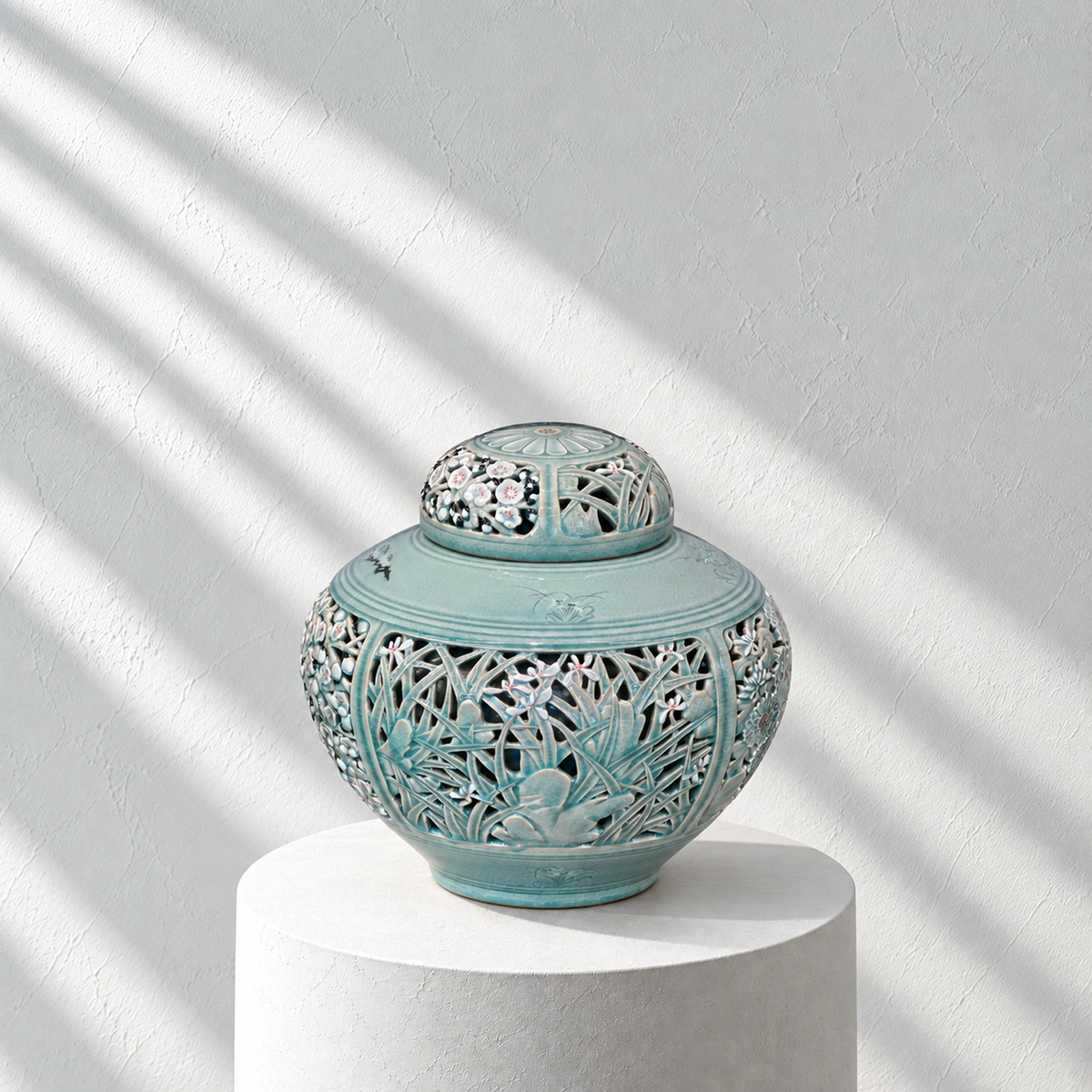
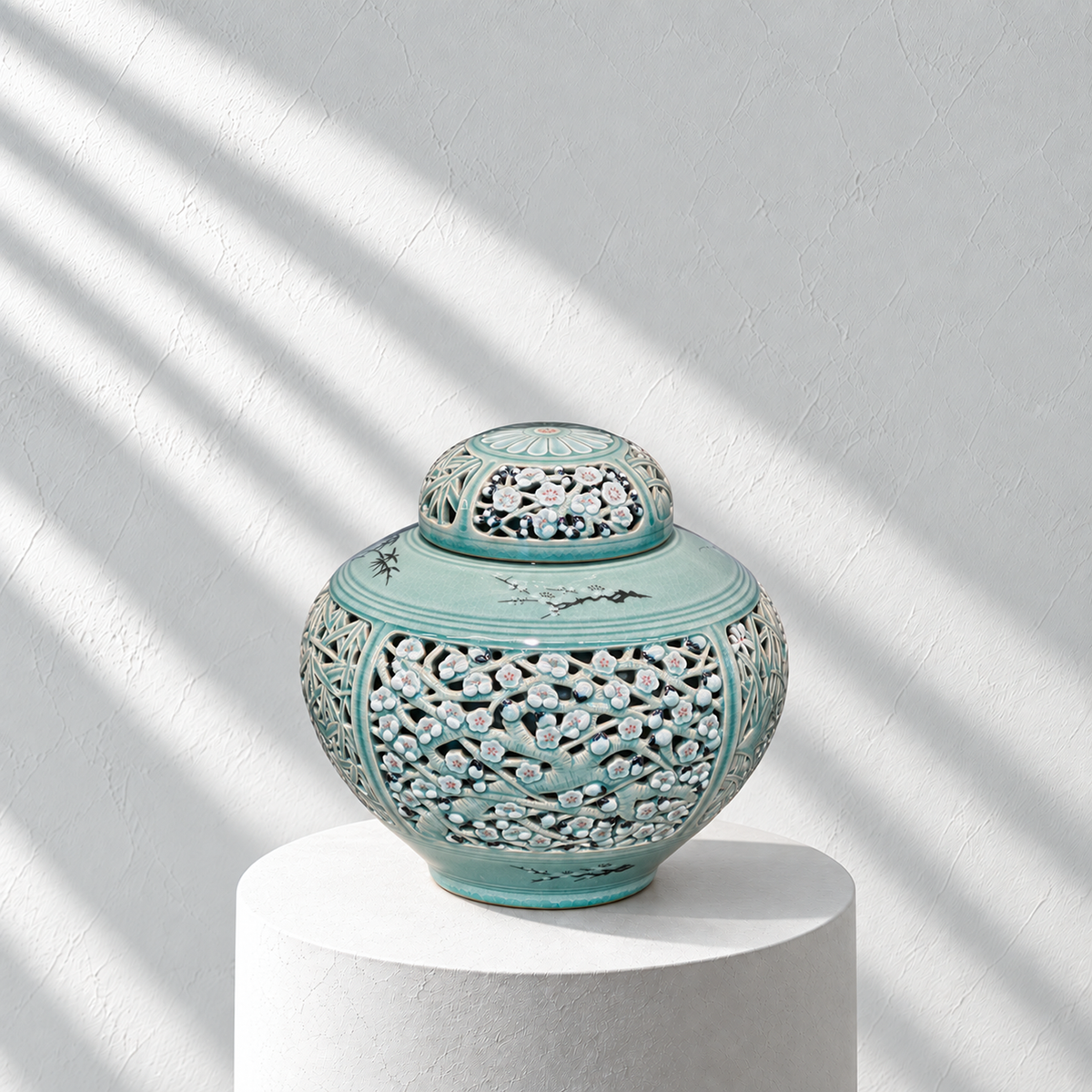
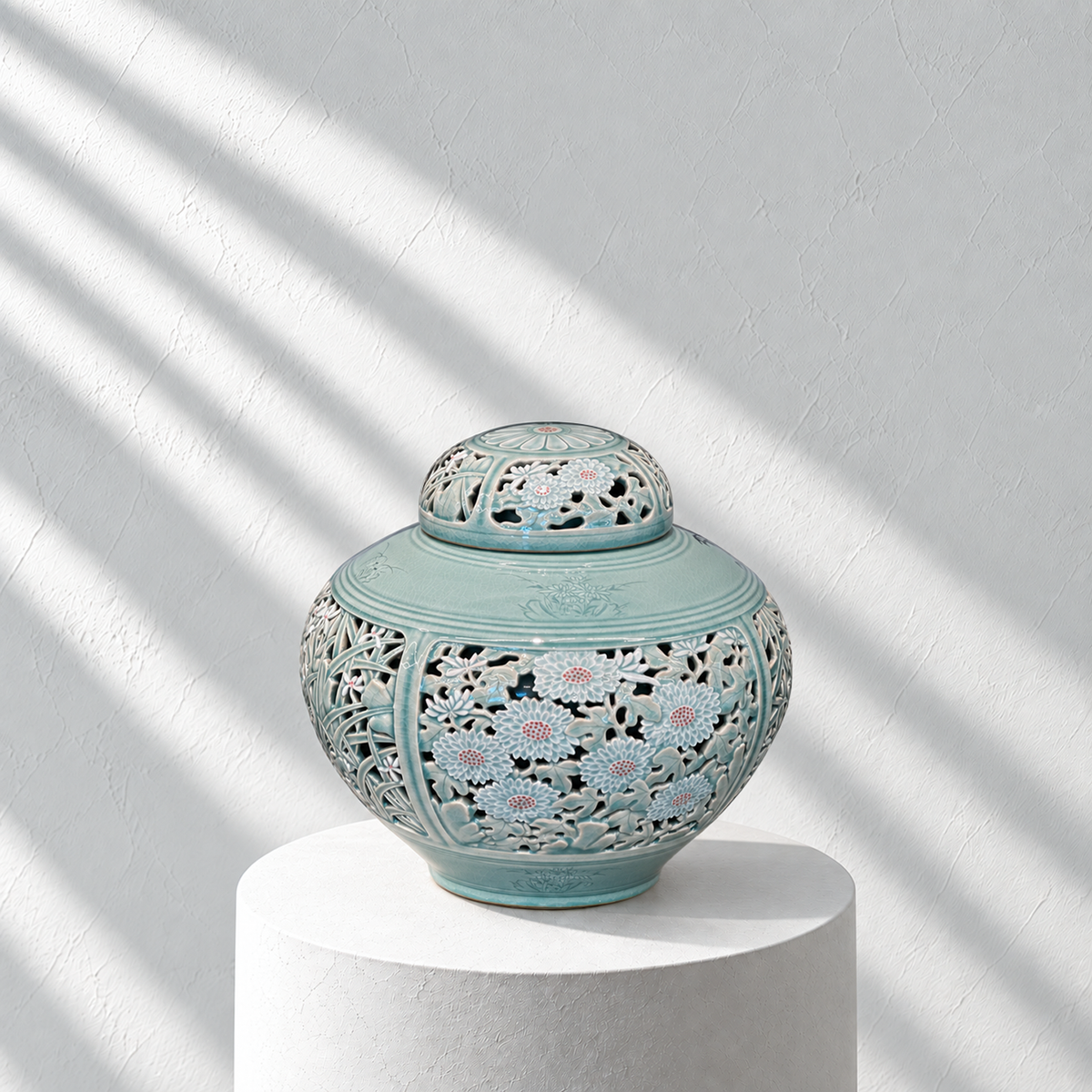
Kim Young-soo's 2021 Celadon Double-Walled Openwork Lidded Jar with Four Gentlemen Motif is best understood through the way its imagery has been divided. Plum blossom, orchid, chrysanthemum and bamboo are not gathered into a single crowded landscape. Instead, the rounded body is articulated into four principal openwork fields, each functioning almost like a separate framed scene.
The choice gives the vessel an unusual rhythm. A round ceramic body naturally encourages continuous decoration, yet Kim introduces pauses and divisions. As the jar is turned, one plant recedes and another enters view. The Four Gentlemen therefore become a sequence rather than a pattern.
This sequential structure suits their place within Korean visual culture. The four plants were admired not merely because of their appearance, but because each came to suggest a different quality of cultivated character. The plum blossoms while winter has not fully withdrawn; the orchid carries refinement without excess; the chrysanthemum flowers late in the year; bamboo remains green and upright through changing seasons. Read together, they form no simple allegory, but a group of distinct virtues repeatedly explored in Korean painting, calligraphy and decorative art.
Kim does not attempt to reproduce the appearance of brush painting directly in clay. Instead, he translates the logic of brushwork into ceramic structure.
Branches become supports.
Leaves become directional lines.
Flowers become points of greater relief.
Empty areas become actual openings through which the inner vessel is visible.
That transformation is central to the work.
In double-walled openwork, the space behind the motif is not merely an illusion of depth. It physically exists. Kim first forms an inner vessel and a separate outer body, leaving a deliberate interval between them. The outer body is subsequently fitted around the inner vessel before being pierced and worked. Every opening must be considered in relation to what remains: too much removal weakens the structure; too little makes the design visually heavy.
This is why the vertical and curved divisions between the four botanical fields matter. They can be read decoratively, but they are also structural. They prevent the pierced body from becoming a continuous fragile skin and give the composition a visual frame. The vessel's engineering and its imagery are therefore inseparable.
Within each field, Kim varies the handling of the clay. Some leaves are described through shallow lines, others through raised edges. Blossom centres receive minute touches of coloured clay, while branches and stems move between low relief and fully opened areas. The contrast is subtle, but it keeps the surface from flattening into a repeated perforated pattern.
The lid is particularly revealing of Kim's approach. It could easily have been left plain, allowing the body to carry all of the imagery. Instead, it continues the pierced botanical language in miniature. When the lid is seated, the upper register answers the larger scenes below. The eye moves from the pierced body to the quieter shoulder and then upward again into openwork.
The transition gives the jar a deliberate vertical order.
Its rounded body, broad shoulder and relatively compact mouth also help control the density of the decoration. The openwork occupies the central volume, where the curvature is widest and the motifs have room to expand. Above and below, more solid ceramic bands steady the composition. The result is not an evenly decorated object; it is one in which open and closed areas have been carefully distributed.
This becomes most apparent when the jar is viewed in the round. From one side, the stems and leaves form a dense screen. A slight turn opens larger areas of darkness behind the carving. Another turn brings a blossom forward. The object never offers the whole programme in one frontal view, and this is part of its strength. To understand the jar, the viewer must move around it.
The Four Gentlemen were often subjects for individual paintings, and there is something of that tradition retained here. Each plant is allowed a moment of independence. Yet the ceramic body joins them physically, making the vessel not simply a container for four motifs but a structure through which four different images are brought into relation.
Kim's mastery is most visible where it does not announce itself: in the narrow branches that remain intact after piercing, in the controlled distance between the two ceramic walls, in the points where relief becomes open space, and in the fact that the lid, body and imagery still read as one object.
The result is a vessel in which technique is extensive, but never becomes the subject by itself. What remains in view is the quiet progression of four plants around a single celadon form.
Dimensions
- Height- 32 cm (12.6 inch)
- Diameter- 32 cm (12.6 inch)
Choose options