
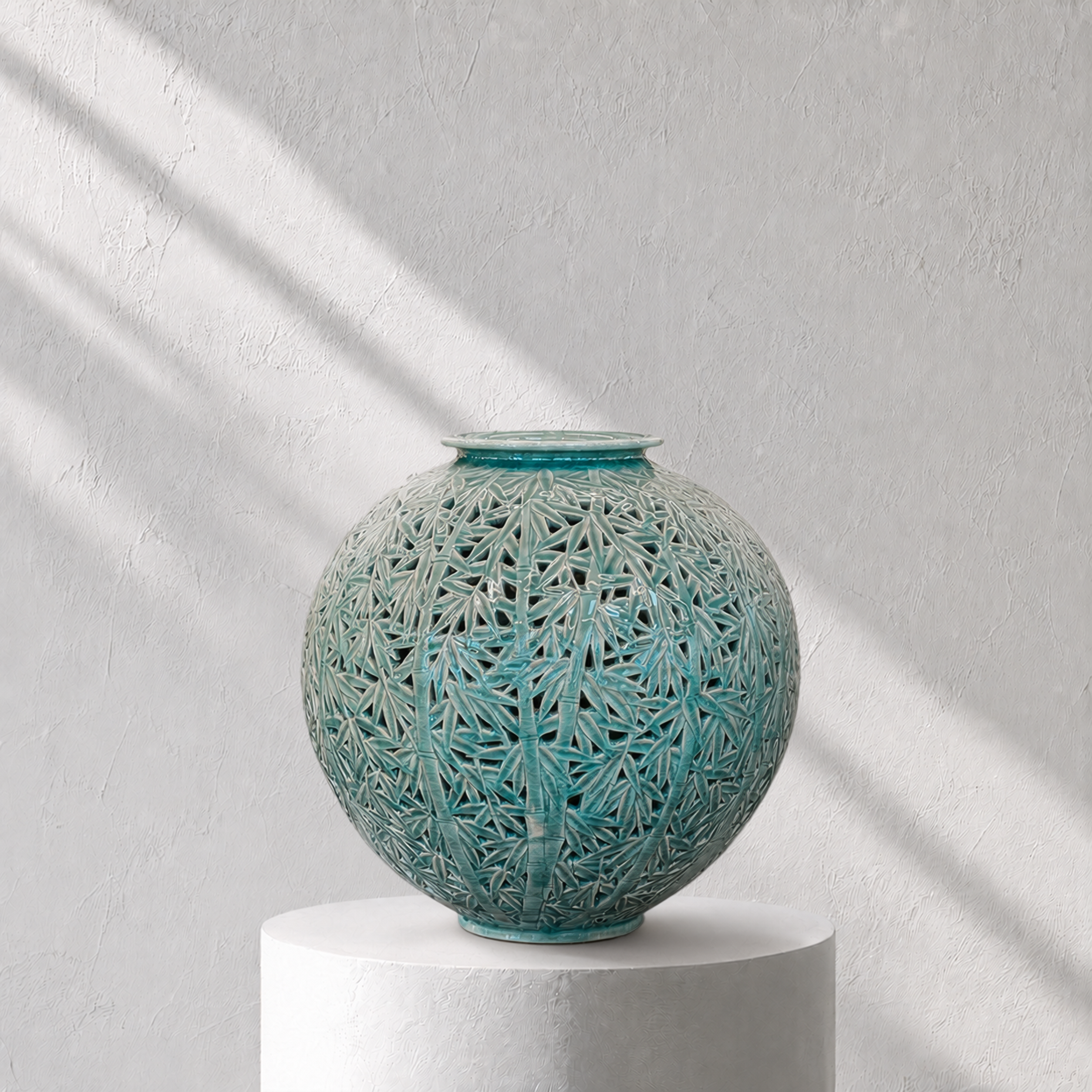


Celadon Double-Walled Openwork Vessel: Bamboo Motif
This vessel is chosen by those who understand that discipline may be most clearly perceived where solid material has been taught to accommodate emptiness.
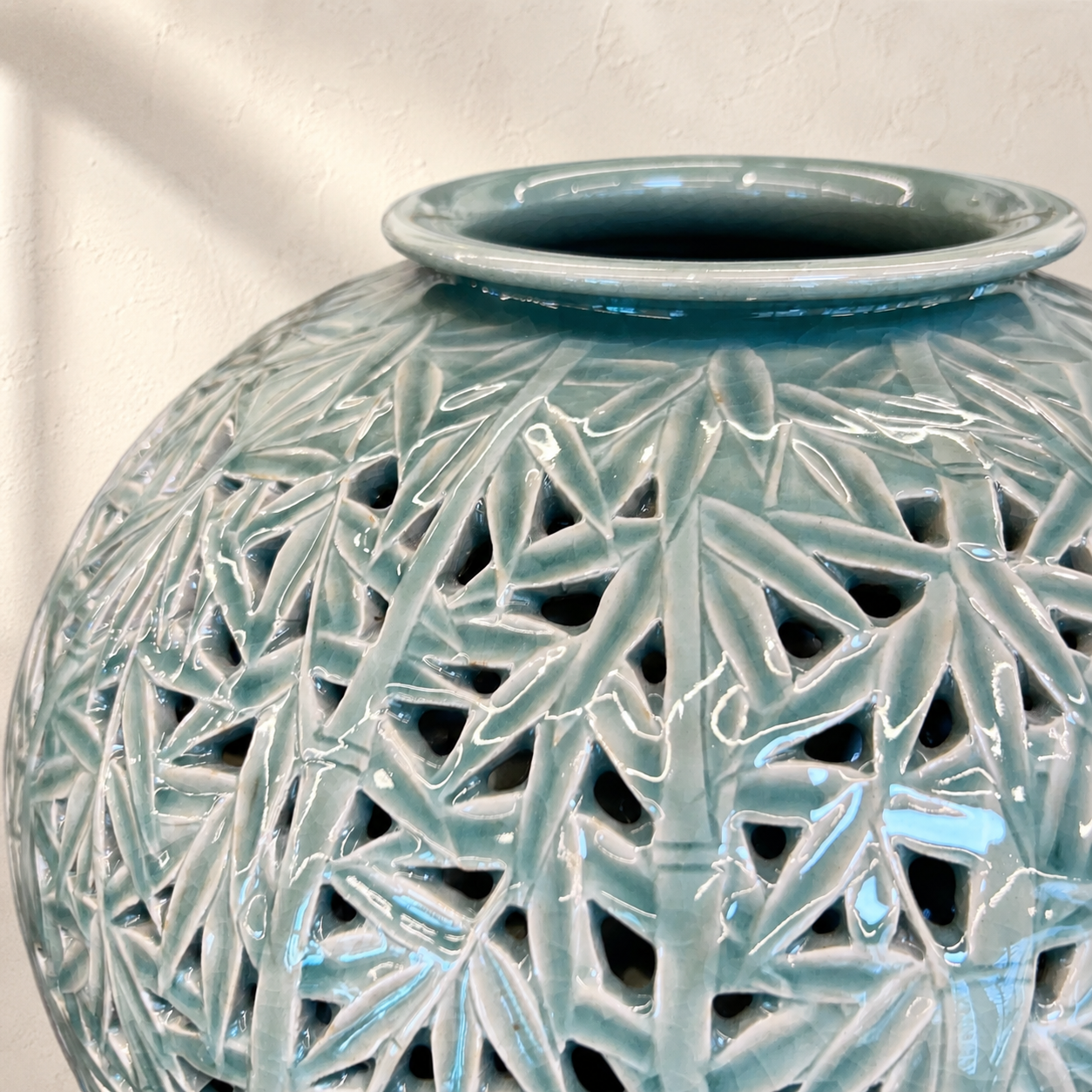
“The bamboo does not merely cover the surface; it holds the air around the vessel in a pattern of stems, leaves, and shadow.”
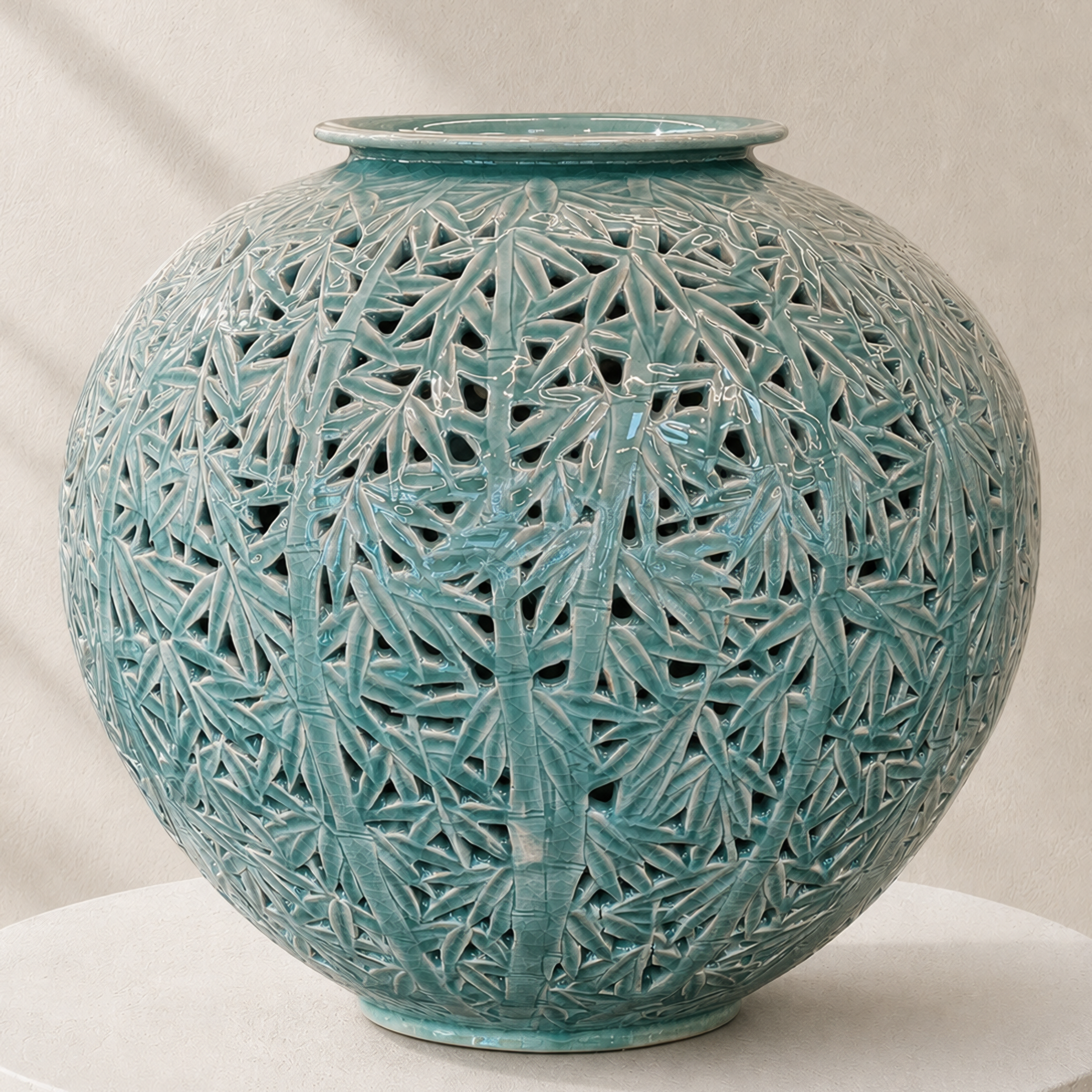
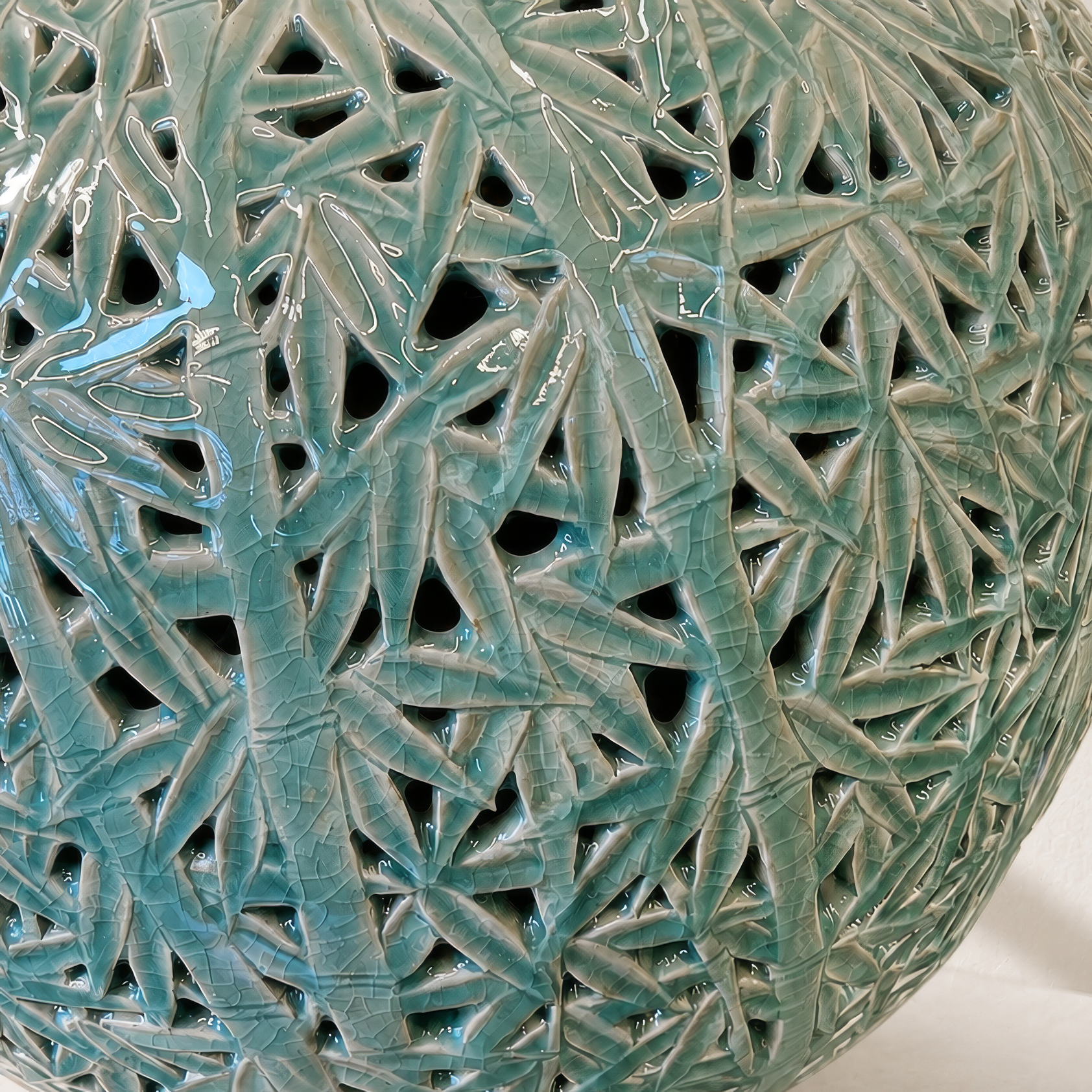
Created by Kim Young-soo, Master Ceramic Artisan of Icheon, this celadon vessel brings together two demanding orders: the organic irregularity of a bamboo grove and the exact structural judgement required by double-walled openwork. The work’s quiet authority arises from the way these orders have been reconciled. What first appears to be abundant natural growth is also an intricate supporting system, calculated so that the outer shell remains coherent after much of its material has been removed.
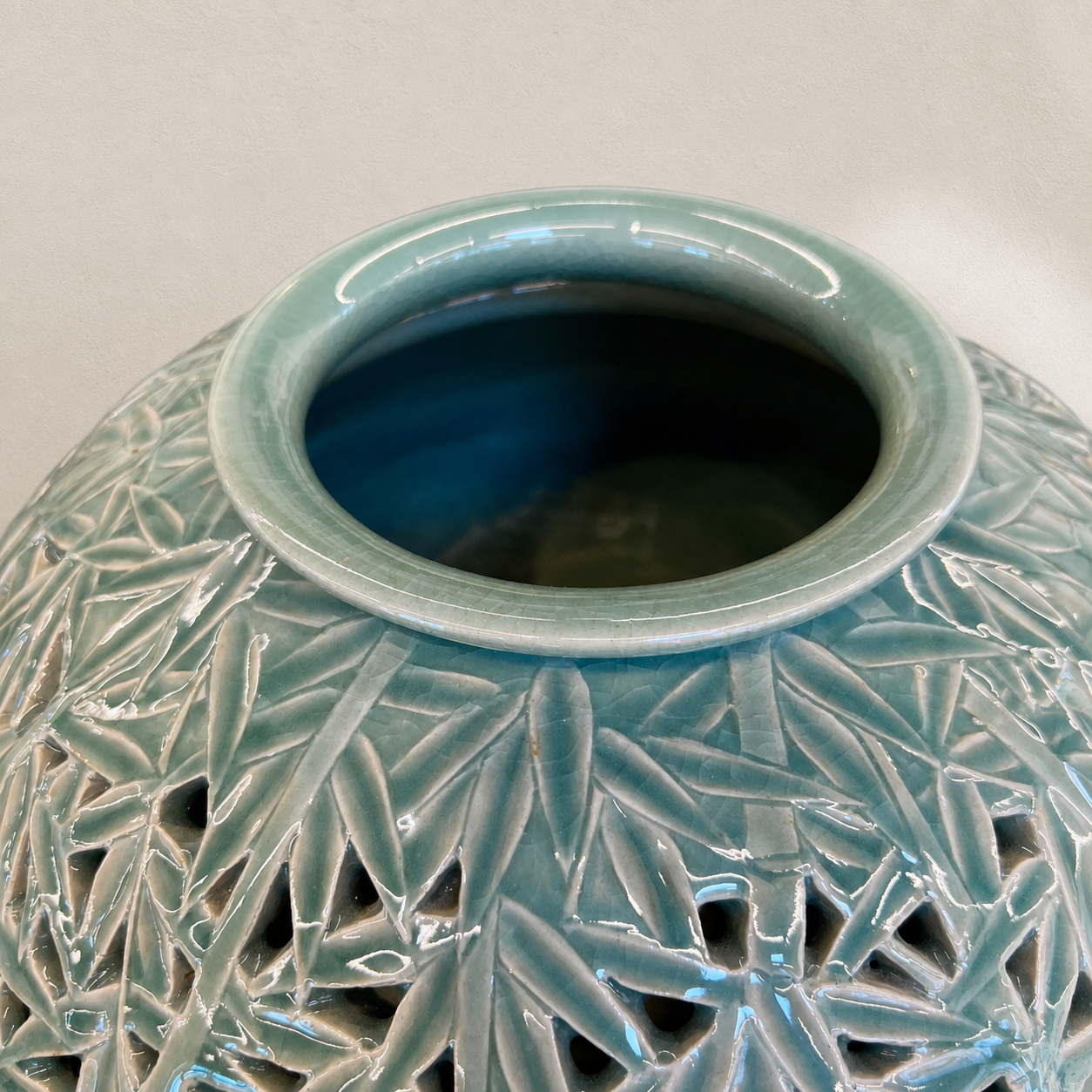
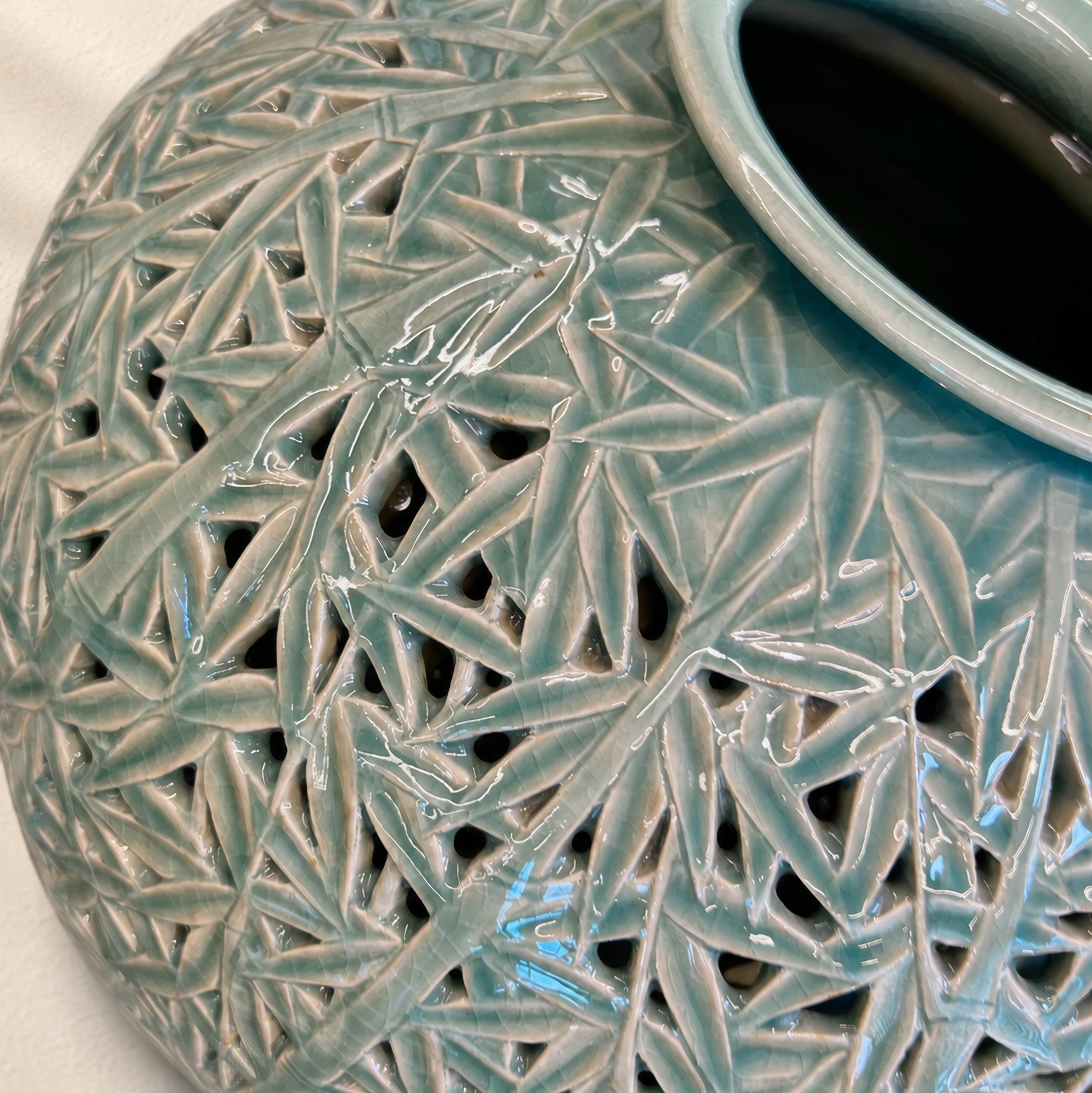
The vessel begins with an inward and outward body. The inner jar preserves the fundamental idea of containment: it is continuous, sheltered, and visually withdrawn. Around it, the outer shell establishes another kind of body, one defined not by enclosure alone, but by the relationship between clay and aperture. Kim’s process requires the outer form to be opened, placed around the inner vessel, joined, and then gradually pierced and modelled. The completed work is therefore not simply hollow. It contains a deliberate interval between two ceramic skins.
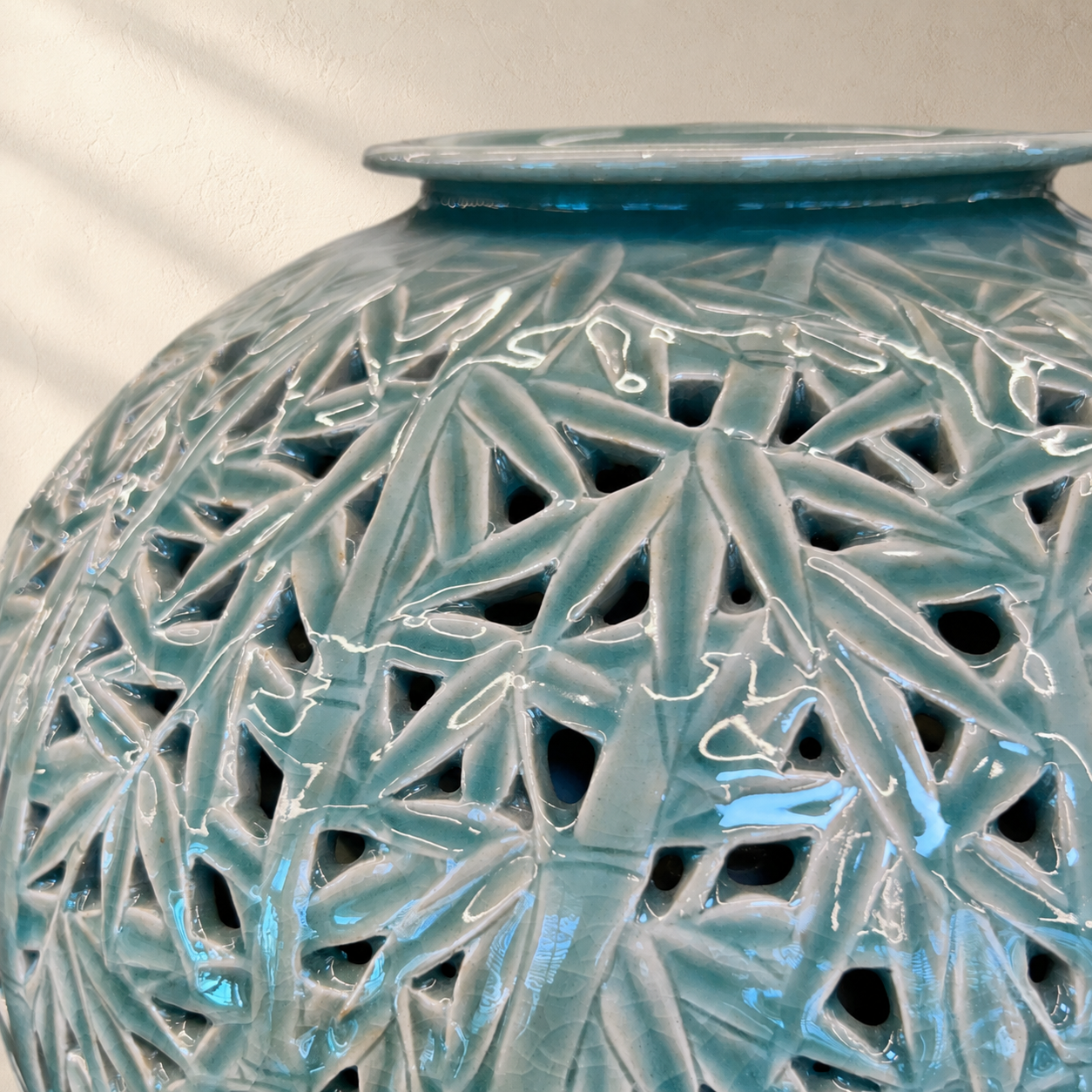
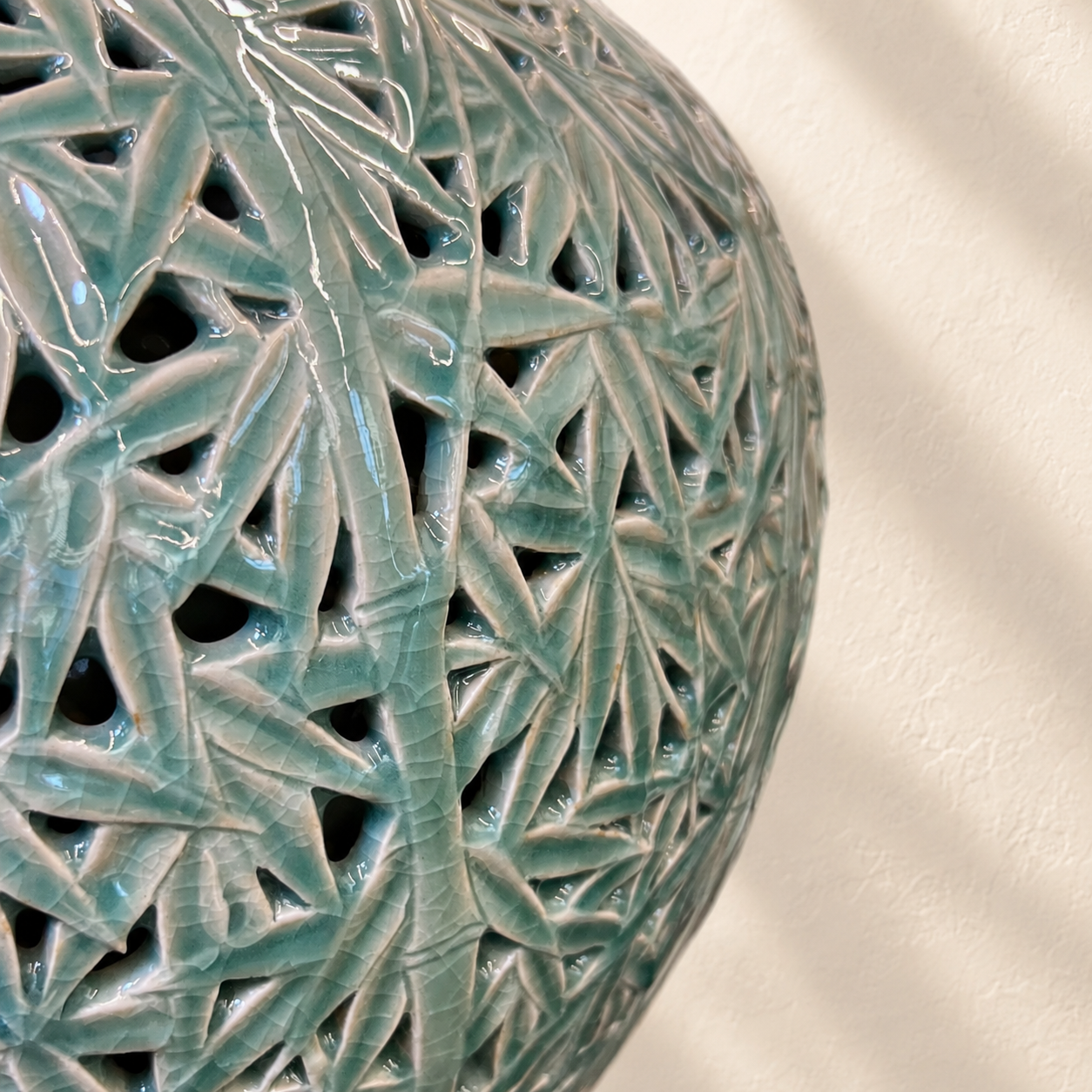
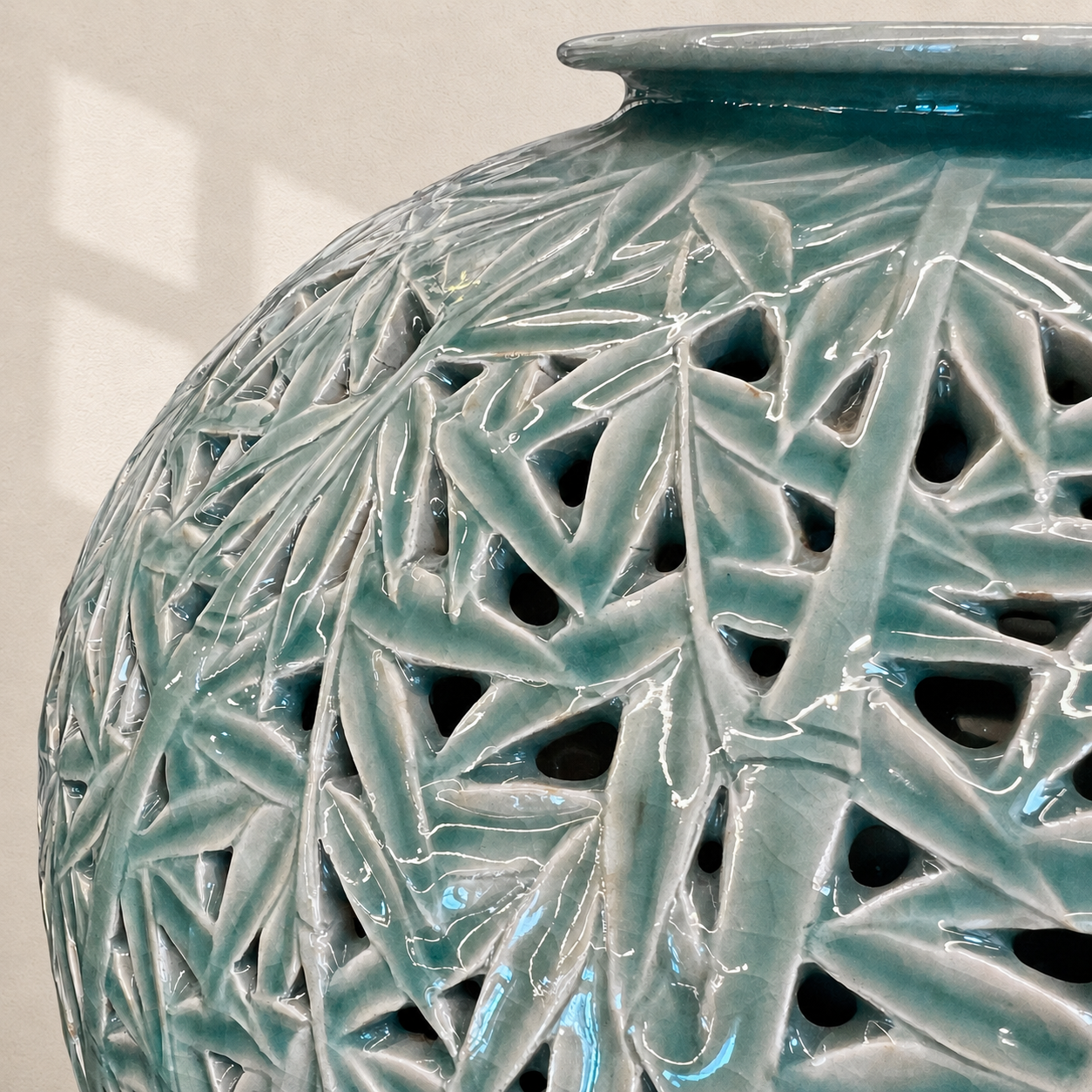
That interval is central to the experience of the piece. Viewed directly, the bamboo appears dense and nearly continuous. Viewed from an angle, the openings reveal the inner wall and the depth separating it from the carved exterior. The eye moves through three distinct conditions: glazed relief, darkened space, and the calmer interior surface beyond. The motif is consequently perceived not only across the vessel, but into it.
Bamboo provides a particularly intelligent language for this construction. The stems form long structural continuities, rising from the lower body and crossing the rounded volume with an almost architectural firmness. Their articulated nodes interrupt the vertical movement at measured intervals, giving each stalk a sense of growth rather than mechanical repetition. Between them, the leaves spread diagonally, intersecting and overlapping. These diagonals resist the stillness of the upright stems and give the grove its internal energy.
The maker has arranged the composition so that solidity and openness remain interdependent. Were the stems too isolated, the outer wall would lose both visual and physical continuity. Were the leaves too densely joined, the work would no longer possess the clarity of openwork. The present arrangement preserves a controlled tension: enough clay remains to hold the body together, yet enough has been removed for light, shadow, and the inner vessel to participate in the composition.
The Korean symbolism of bamboo deepens this structural reading. Bamboo has traditionally represented moral integrity, endurance, and constancy. Its hollow centre could be associated with modesty and receptiveness, while its segmented yet continuous growth suggested disciplined development. It bends in wind but retains its rooted character. Within this vessel, such meanings are not appended to the form after its making. They are embodied by the method itself. Strength is achieved through flexibility; continuity survives through carefully managed openings; apparent delicacy depends upon internal discipline.
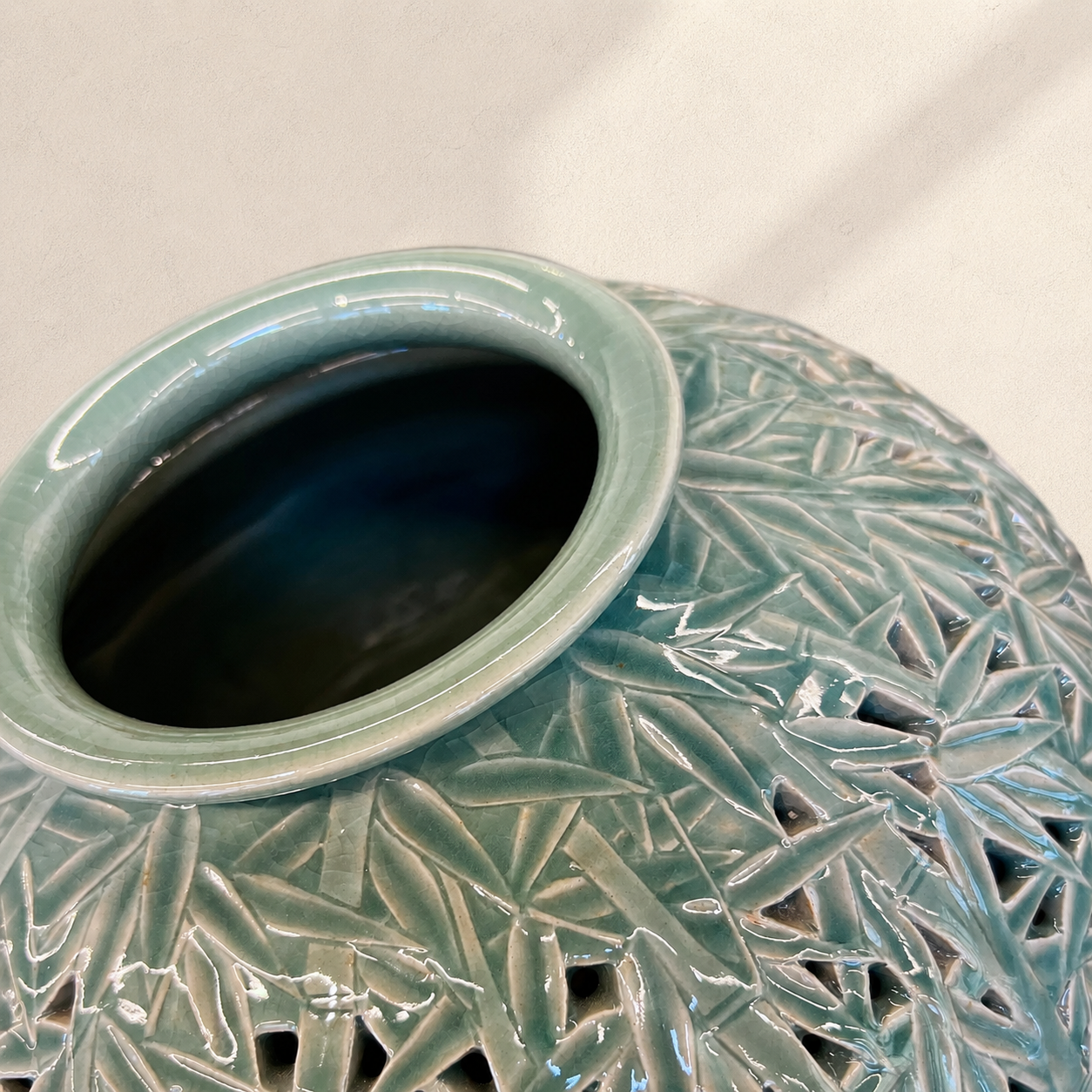
The spherical body allows the bamboo to exist without a privileged front. This is significant. A painted scene may guide the viewer towards a principal viewpoint, but this work denies such immediate completion. Rotation is required. As the vessel turns, stems that first seemed independent become connected through branches and leaves; apertures align briefly with one another and then separate; the inner wall appears through different depths. Repeated viewing does not merely reveal additional decoration. It reveals how the object has been structurally reasoned.
The mouth introduces a contrasting geometry. Broad, circular, and comparatively undecorated, it holds the top of the vessel in a state of calm. It also declares the continued presence of the inner jar. The viewer can look into a true vessel opening even while the surrounding body appears almost transformed into a pierced screen. Containment and permeability therefore coexist without cancelling one another.
The celadon glaze further unifies these conditions. It settles into incised lines and around the bases of the raised leaves, sharpening the separation between one element and another. Along projecting edges, the glaze becomes lighter and more reflective; in deeper recesses, it appears cooler and more concentrated. The surface is consequently never optically flat. It changes as one moves, and the openwork alternates between reading as a tangible grove and as an arrangement of illuminated contours.
The large rounded body intensifies the technical risk of the process. A broad outer shell must dry evenly while remaining separated from the inner vessel. Each opening alters the distribution of tension, and every narrow connection must withstand handling, glazing, and kiln heat. The work’s visual abundance therefore rests upon a severe economy of judgement. Nothing may be removed without consequence, and nothing may remain without purpose.
Kim has spoken of major openwork pieces as works that can demand exceptional periods of making and drying, with the most complex examples remaining under his direct control throughout the process. This context clarifies the vessel’s composure. Its calmness is not the absence of difficulty, but difficulty brought into order.
Ultimately, the piece presents bamboo not as a decorative emblem, but as a way of organising matter, space, and attention. The outer grove protects without sealing; the inner jar remains present without insisting upon itself. Between them lies a measured field of air. In that interval, the cultural meaning of bamboo and the physical intelligence of the object become inseparable.
Dimensions
- Height- 36 cm (14.17 inch)
- Diameter- 35 cm (13.78 inch)
Choose options